In April, the world watched urea prices go through the roof. With shipping through the Strait of Hormuz disrupted, the average world price nearly doubled in weeks to $857 a tonne. From Iowa to Eldoret, farmers planning their next season did the sums and winced.
For urea, it did. By September the price was back near $408, about where it started the year. As Chinese exports resumed, the panic faded.
But ask a farmer whether farming got cheaper again, and you will hear a different answer. The World Bank's Africa Economic Update for October 2026 explains why. The war in the Middle East did not just raise one price. It pushed up a whole set of costs, and several of them have stayed high.
The fertilizer that stayed expensive
Urea is the fertilizer most farmers use to top-dress. For planting, many Kenyan farmers use DAP, which supplies phosphorus. And DAP has kept climbing.
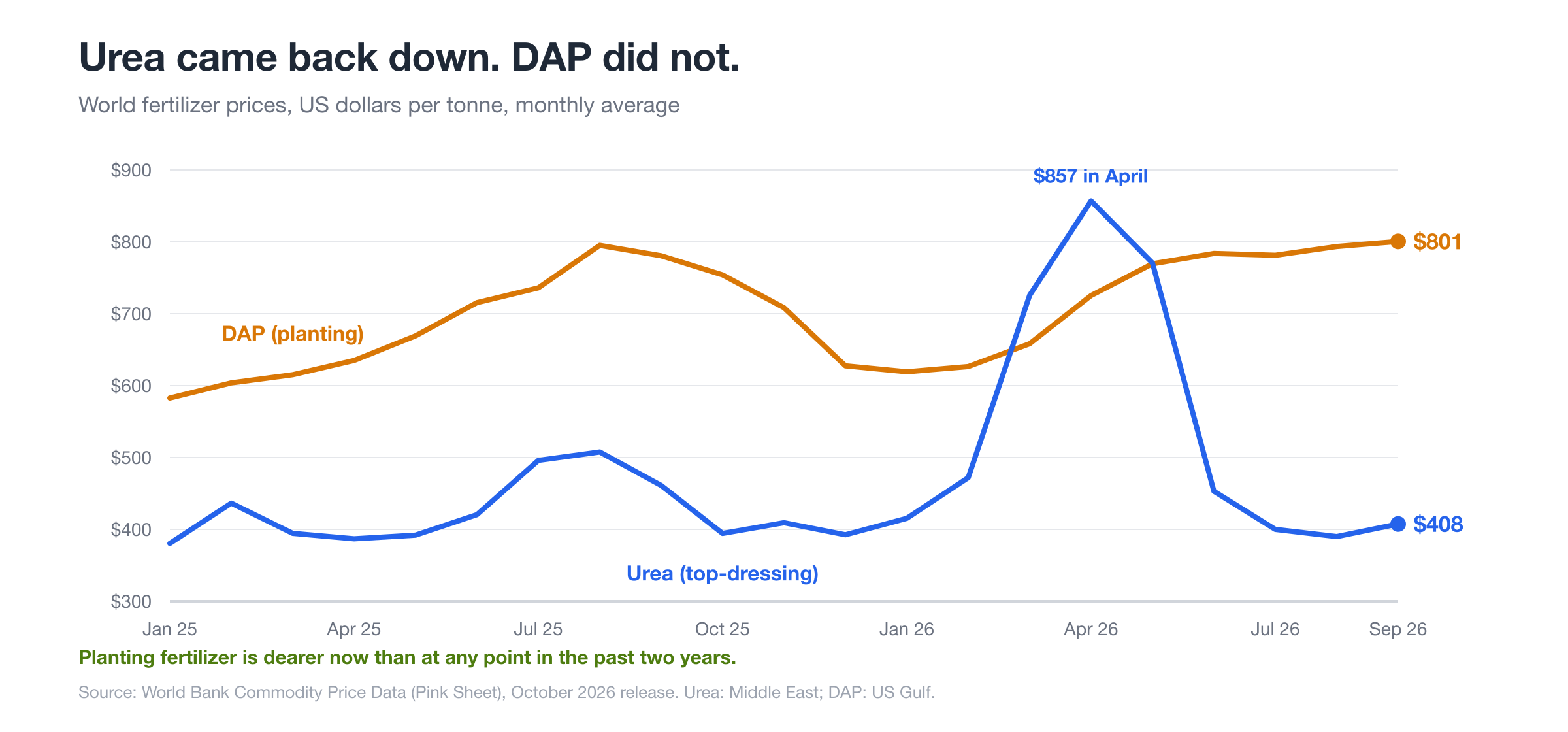
According to the World Bank's commodity price data, DAP averaged about $801 a tonne in September 2026, higher than at any point in the past two years and about 44% above its level in September 2024. The report links this to a shortage of sulphur, which is needed to make phosphate fertilizer, and to continued disruption of trade with the Gulf, where a large share of the world's sulphur is produced.
So a farmer who buys mainly urea has seen some relief. A farmer whose biggest bill is planting fertilizer has seen very little.
In Kenya, the government has tried to soften the blow. In August it cut the price of a 50 kg bag of subsidised fertilizer from KSh 2,500 to KSh 2,000 for registered farmers. That helps those who can get it. Many others still buy at commercial prices, which follow the world market.
The rising cost of diesel
Fertilizer is only part of the story. The report notes that markets for refined fuels such as diesel have been hit even harder than crude oil, because refineries in the Middle East and Russia have been disrupted.
In Kenya, the average price of diesel in Nairobi jumped from about KSh 167 a litre in February to KSh 233 in May, according to KNBS figures based on EPRA data. In August it was still about KSh 218, almost a third higher than before the war.
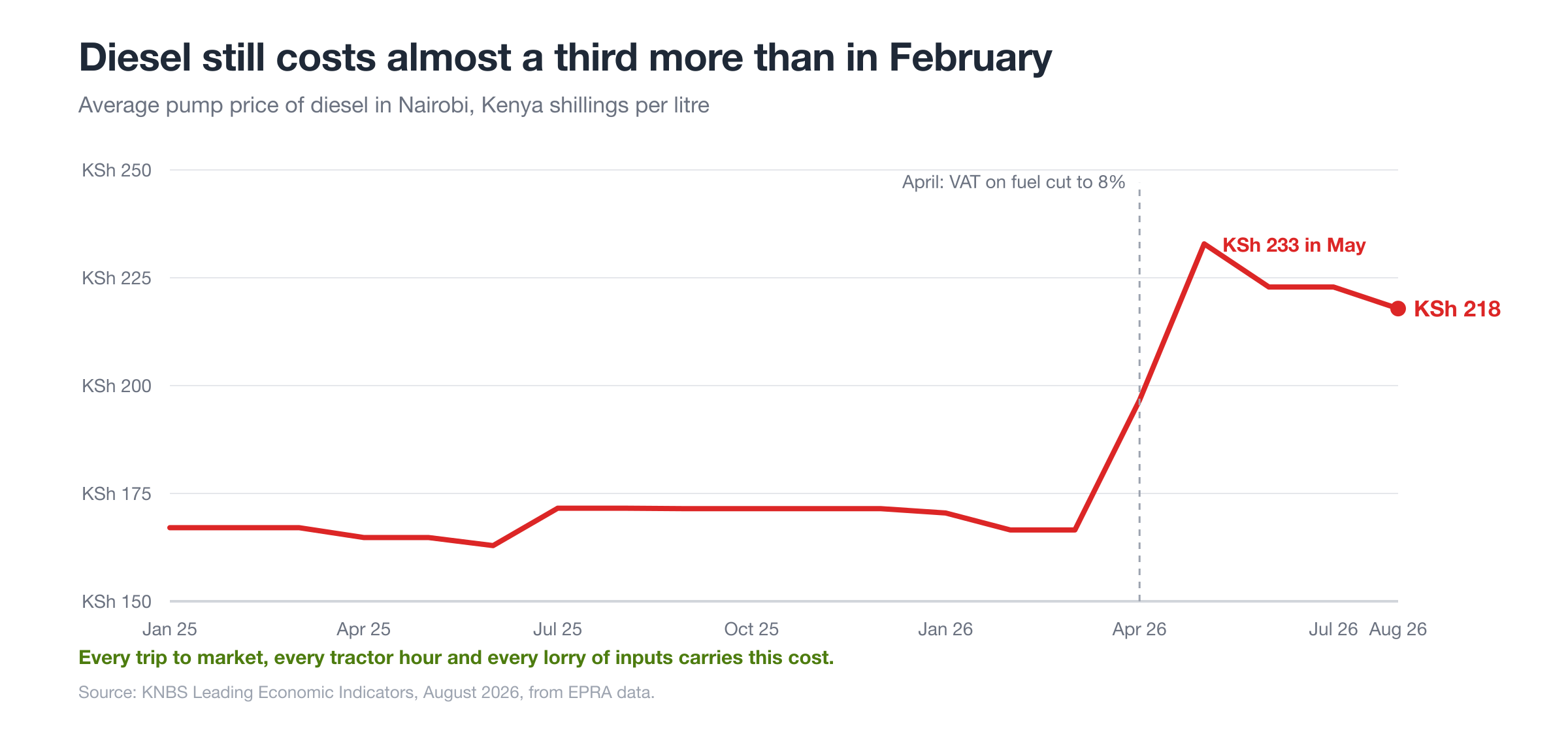
That is even after the government halved VAT on fuel from 16% to 8% in April. In October, members of parliament voted to keep the lower rate for another 90 days. Without that cut, pump prices would be higher still.
Diesel touches almost everything on a farm: ploughing, pumping water, running a posho mill, and every lorry and boda boda that carries inputs in and produce out. When transport costs rise, the price gap between what a farmer gets at the farm gate and what a buyer pays in town tends to widen.
Food prices are rising too
There is a brighter side for farmers who sell grain. World grain prices have climbed over the past year.
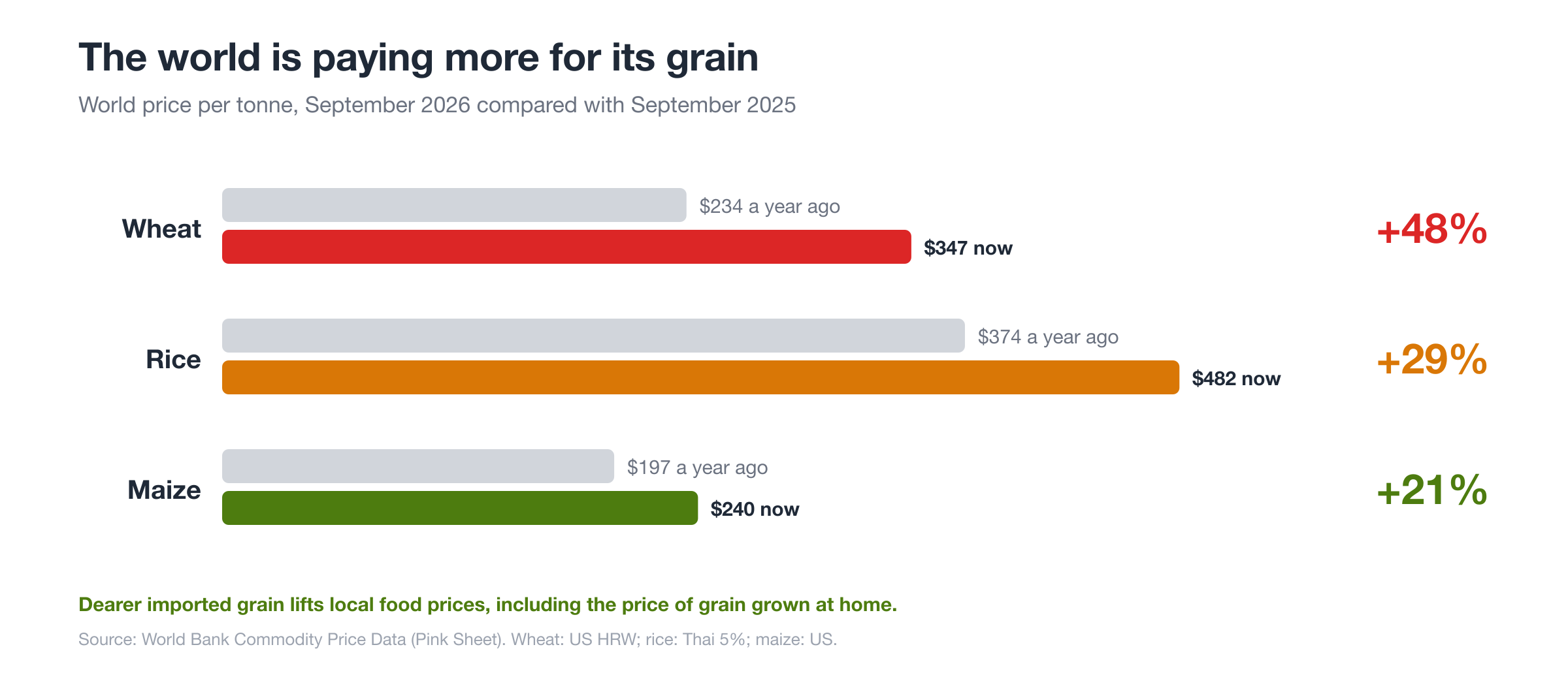
Wheat was 48% dearer in September 2026 than a year earlier, rice 29% and maize 21%. The report adds that a strong El Niño is likely to squeeze harvests in Southern Africa next year, which could keep regional grain prices firm.
Higher prices are good news for a farmer with a surplus to sell. They are hard on families who buy most of their food, which includes many small farmers in the months before harvest. And they only help if farm costs do not rise faster than the selling price.
Five ways to protect your margin
Price the whole season, not just the bag. Add up fertilizer, seed, labour, transport and diesel before you plant, and compare it with a realistic selling price.
Test before you buy phosphorus. DAP is now the expensive bag. A soil test shows whether your field needs it all, or whether a smaller amount will do. Our guide to making every bag of fertilizer pay explains how.
Register for subsidised inputs. In Kenya, make sure your details are up to date in the national farmer register so you can get subsidised fertilizer and seed.
Share transport. Buying inputs and selling produce as a group through a cooperative or farmer group cuts the cost per bag and per kilo.
Store and sell at the right time. With grain prices firm and the risk of a poor harvest in the south, well-dried, well-stored grain may fetch more in a few months than at harvest.
Oil and fertilizer prices will keep moving with the news from the Gulf. Farmers cannot control that. What they can control is how carefully each shilling is spent. For practical lessons on farm budgeting, record keeping and input use, explore the courses on Eagmark Training.
This article draws on figures from World Bank. 2026. Building AI Readiness. Africa Economic Update (October 2026). Washington, DC: World Bank. License: CC BY 3.0 IGO.