Almost every decision about how the world farms begins somewhere very ordinary: the plate. What people choose to eat sets off a chain that runs all the way back to the soil, deciding which crops are planted, how many animals are raised, and how much land is put to work. Change enough plates, and you change the land itself. It may be the most powerful lever in farming and one of the least discussed.
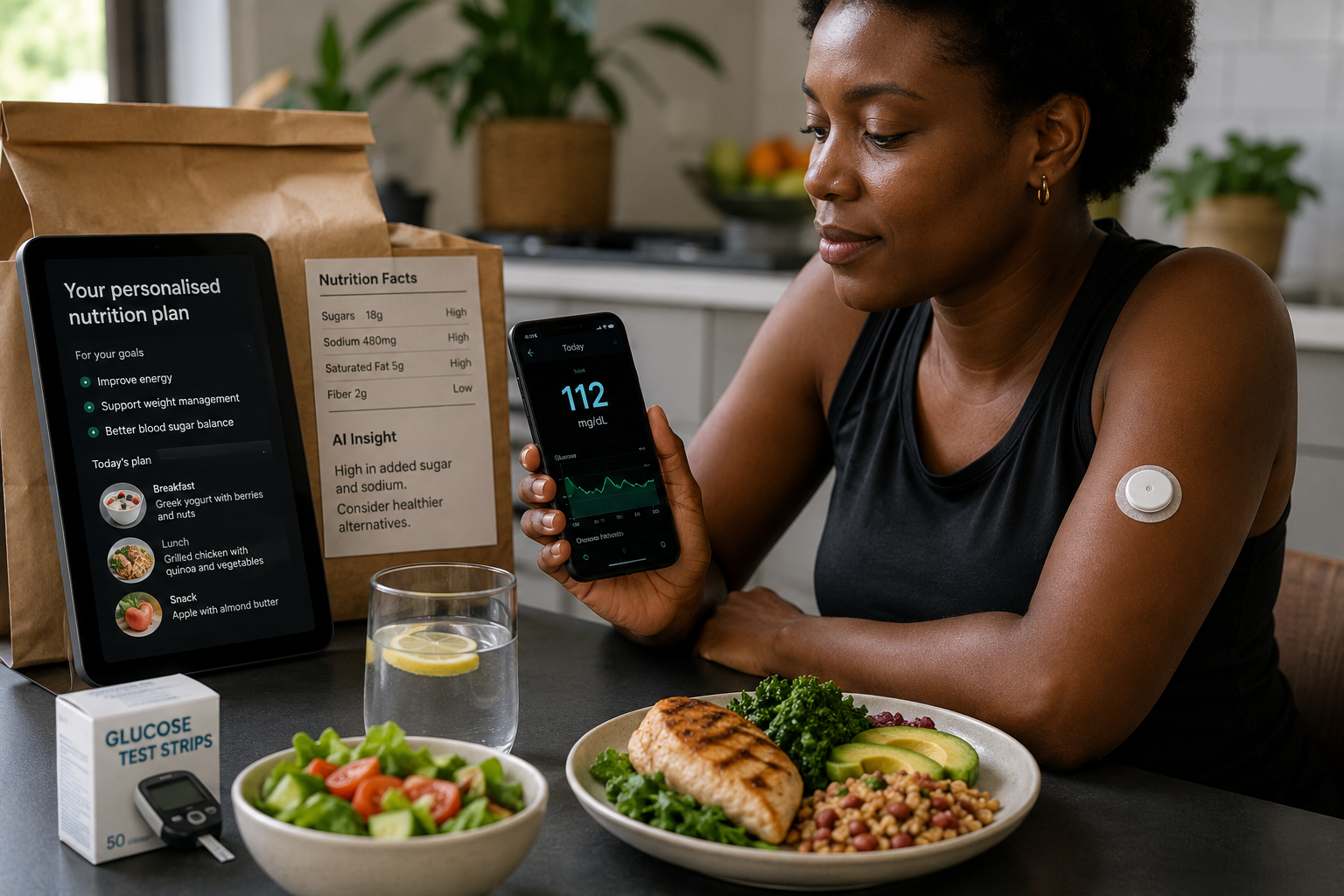
Imagine that lever being pulled. That is roughly what a sweeping new analysis in Nature set out to model: a world where far more people ate the way nutrition experts have long recommended, with more fruits, vegetables, legumes and nuts and less red meat, where less food was wasted, and where farms grew a little more from each acre. The diet it draws on comes from a landmark international commission on healthy and sustainable eating. The striking part is what happens to land. For the first time in modern history, the total area needed to feed everyone could actually shrink. Farmland has only ever expanded, pushing into forests and grasslands. A genuine reversal would be something the world has never really seen.
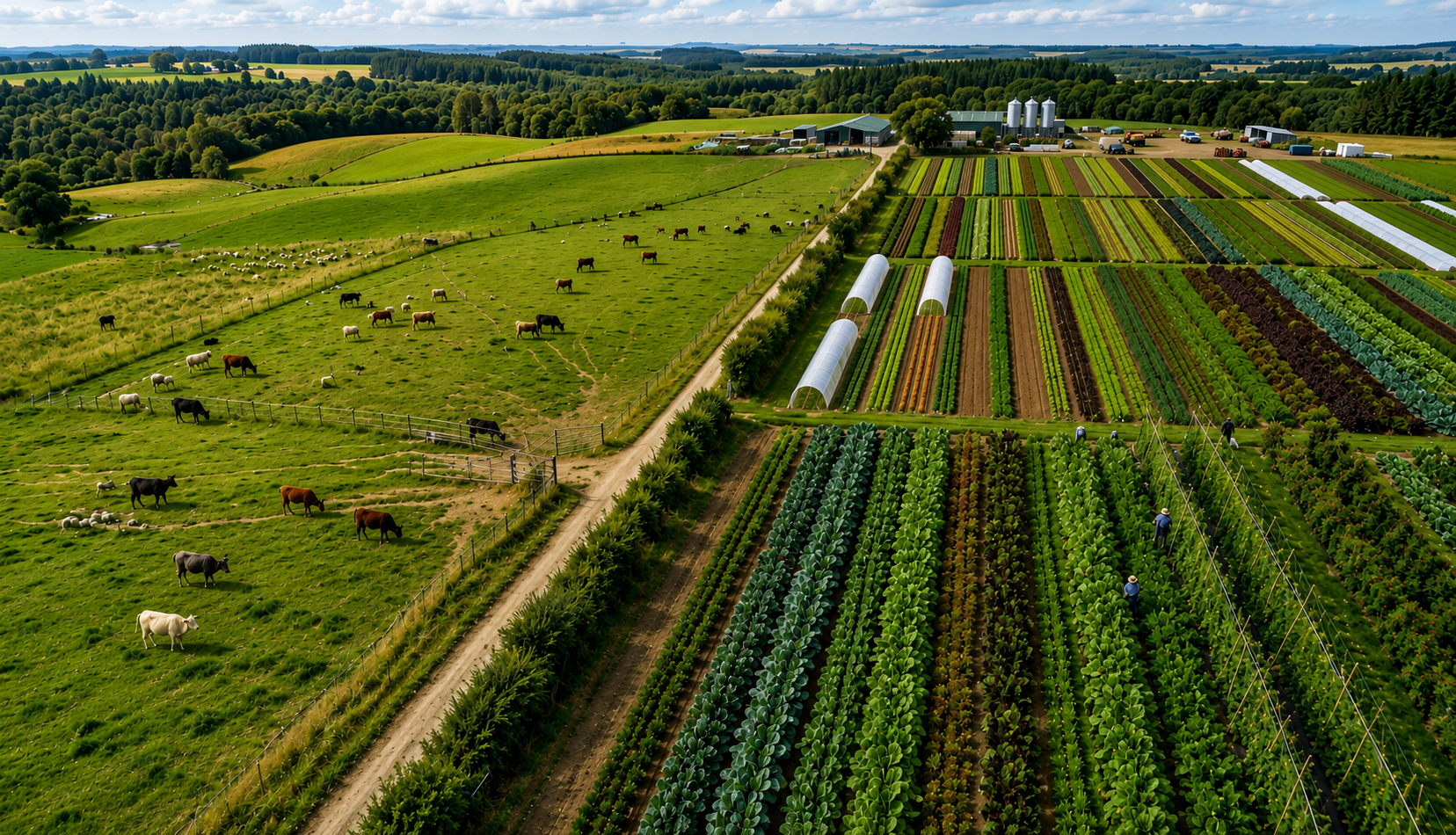
The logic is simple once you follow it. A world that eats differently farms differently. Fewer animals raised for meat means less demand for the vast quantities of grain grown to feed them. Huge stretches of grazing land are no longer needed. The whole farm economy, built for generations around livestock, begins to tilt on its axis. In their place, fruits, vegetables, nuts, and beans move from the side of the plate to the center of it and from the edge of the farm economy toward its heart.
The environmental case is hard to argue with. Growing food is one of the largest sources of the emissions warming the planet and a heavy user of water and fertilizer. Raising fewer animals, especially cattle, would cut those emissions sharply and ease the strain on rivers and soils already stretched thin. Land released from farming could, in time, grow back into forest and habitat, a gift to the climate and to wildlife. The wider planetary-health case for eating this way has been building for years.
And yet this is where honesty matters, because the path is anything but tidy. A change this big would be painful for a great many people. Whole regions have built their economies on cattle, dairy, and feed crops, and the jobs tied to them would not vanish gently. Some places would gain as they shifted toward growing more plants; others would face hard, destabilizing transitions.
You can see that tension in a single country. In the United States, the same modeling projects the value of livestock production collapsing by nearly three quarters by 2050, even as the value of crops rises. The total is still smaller than before. One sector shrinks, another grows, and the country's farm economy is remade in the space of a generation.
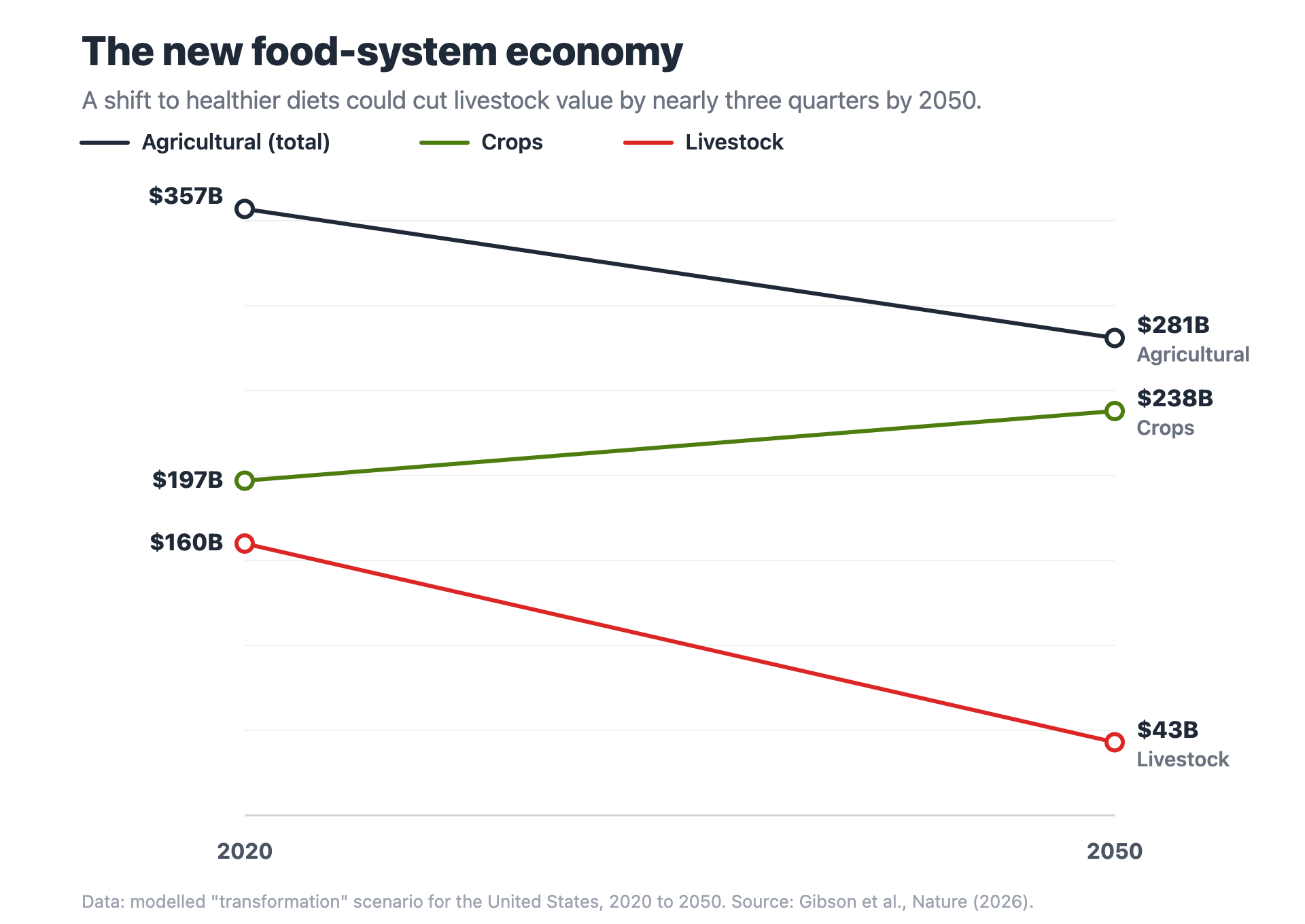
That uneven pain is a large part of why change has been so slow. It is easy to admire the destination and very difficult to move a system that so many livelihoods depend on. It is also why individual choice, on its own, is not enough. The comforting idea that anyone can simply adopt a healthier diet quietly overstates the power of one person's decision. Getting there would take deliberate, coordinated effort: rethinking the subsidies that too often prop up the least healthy and least sustainable ways of farming, supporting and compensating farmers who take on the risk of changing, investing in better methods, and cushioning the communities whose way of life is on the line. Sugar taxes, food labels, and dietary advice all help, but they nibble at the edges of something much larger.
Then there is the human truth that no model fully captures. Food is culture, budget, habit, and identity all at once. For many people, especially those on low incomes, a healthier diet is not a choice they can afford. For others, meat is not about cost at all but about who they are. Change on this scale runs straight into all of that, and pretending otherwise helps no one.
Even so, the size of the prize is hard to walk away from. The food system will change in the coming decades no matter what. The only real question is whether it changes by design, shaped to serve people and the land, or by drift into something that serves neither. Farmers who want to stay ahead of shifting demand can start by understanding what their land is best suited to grow and farming it more sustainably. The rest of us can remember that a fork is a quieter tool than a tractor, and in the end perhaps a more powerful one.