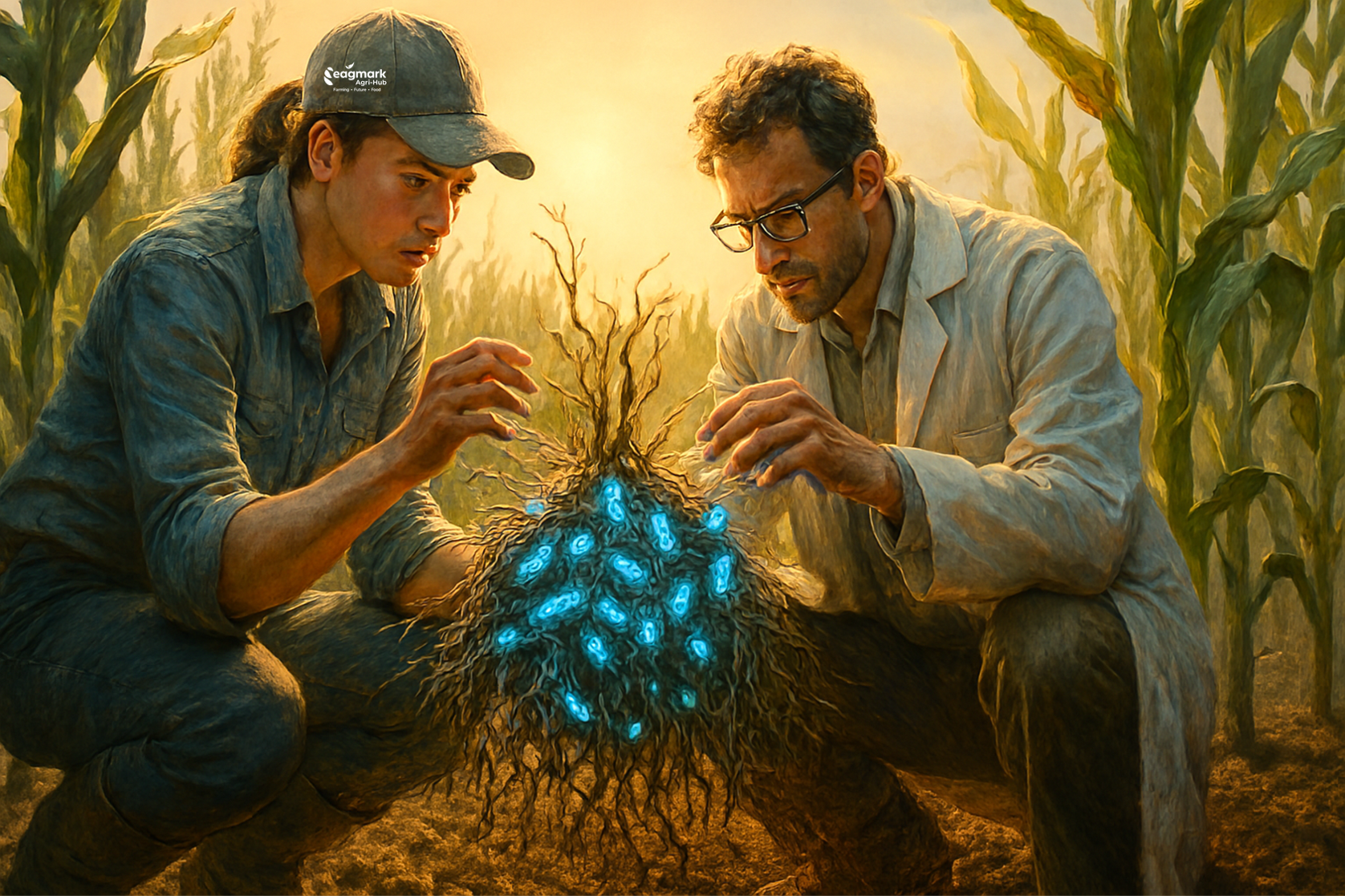
Every country keeps two budgets that never meet. One pays for hospitals. The other pays for farms. Yet the largest single cause of early death worldwide is not a virus or a habit. It is what people eat.
Poor diet was linked to 11 million deaths in 2017, more than tobacco, according to the Global Burden of Disease study published in The Lancet. The world spends around $10 trillion a year treating illness after it arrives. A small group of investors has started asking whether some of that money should go upstream, to the place where food gets its nutrients in the first place.
They call the idea agrihealth. The name is new. The logic is old enough for any grandmother to recognize: you are what you eat, so it matters what your food ate.
The thirty centimeters that feed everything
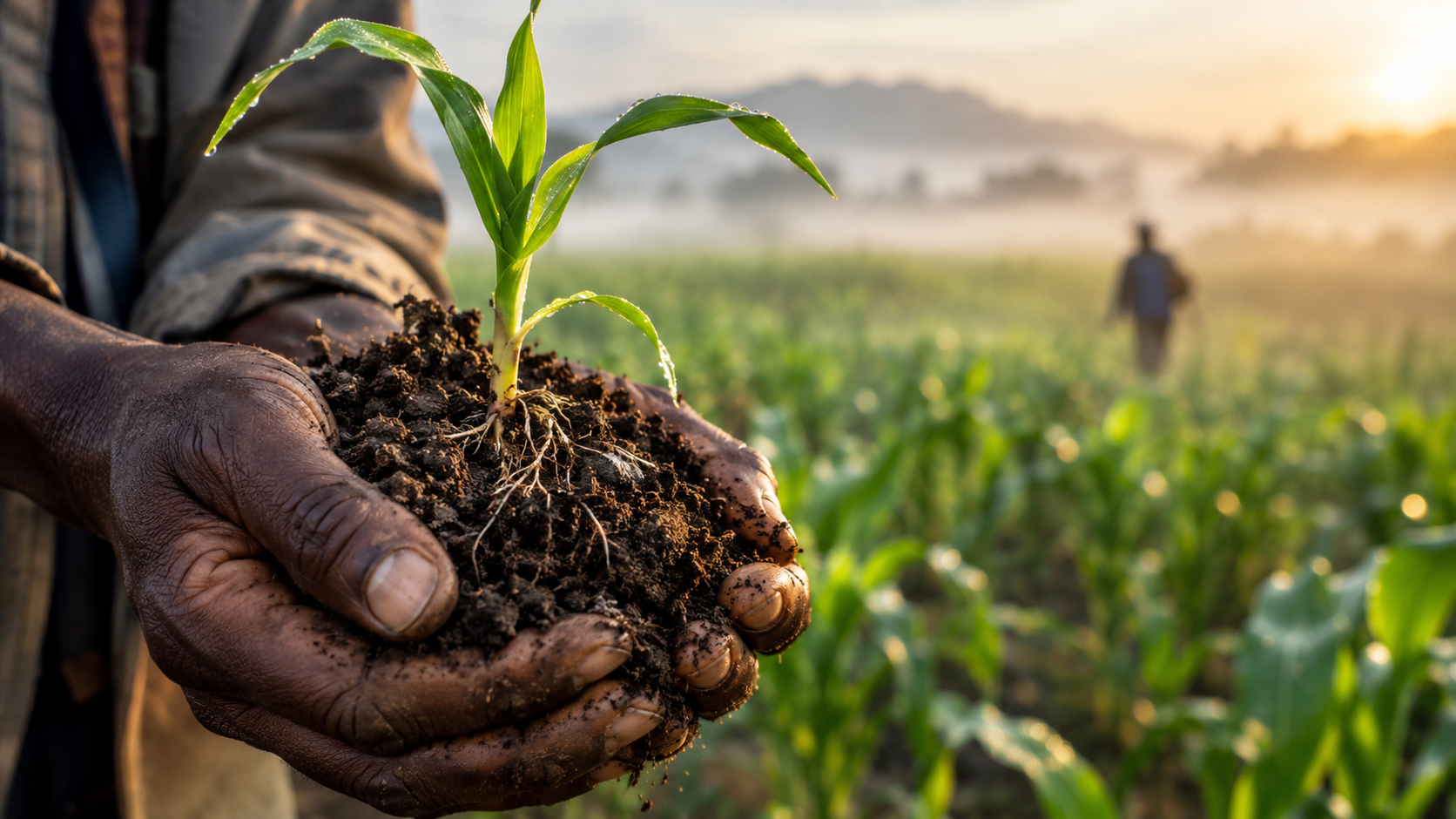
The First Thirty, a London venture firm, takes its name from the top 30 centimetres of soil, the layer that grows nearly all the world's food. Its partners, Antony Yousefian and Naeem Lakhani, are investing €100 million on a single premise, as AgNavigator reported in January: "Fix the soil and you begin to fix human health."
Until recently this was a belief, not a business. Farmers knew that healthy soil grows better crops, and doctors knew that better food grows healthier people, but nobody could afford to measure the chain in between. Reading the biology of a field, a plant or a cow cost too much to do routinely.
That is what has changed.
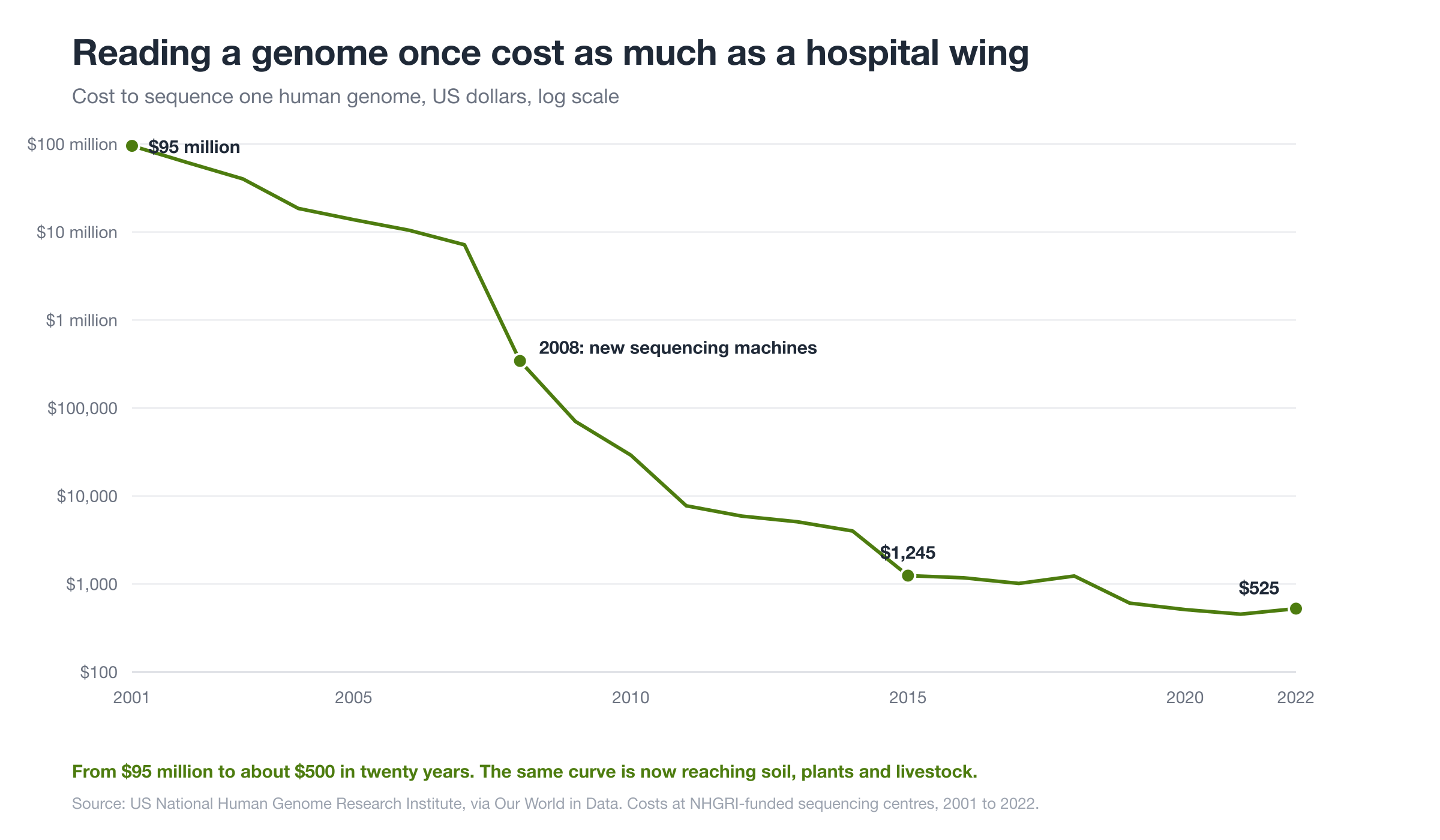
Sequencing a single human genome cost $95 million in 2001. By 2022 it was about $500. The same machines now read soil microbes, plant tissue and livestock blood for a fraction of what a lab charged a decade ago. Sensors have followed the same path. And the cost of making sense of the data has collapsed with artificial intelligence.
At the other end of the chain, people are measuring themselves. Nearly half of American adults now own a smartwatch or ring, according to Rock Health's 2025 survey. For the first time, cheap data exists at both ends of the food system. The bet is that someone will join them up.
Why the question matters everywhere
There is good reason to ask what our food has been eating. When researchers at the University of Texas compared US Department of Agriculture nutrient tables for 43 garden crops in 1950 and 1999, they found that six nutrients had fallen, some sharply.
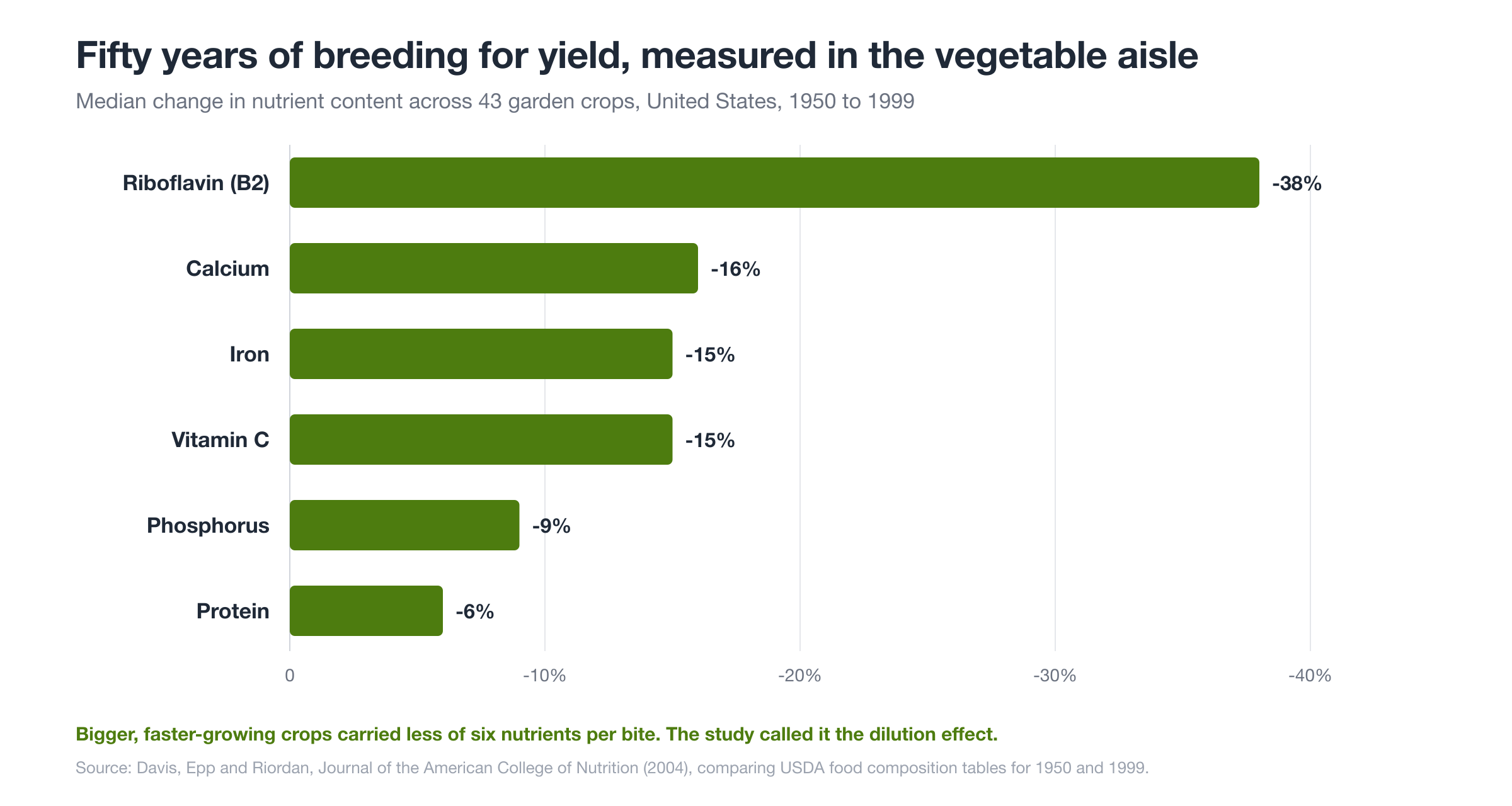
The likeliest cause, the study concluded, was breeding. Fifty years of selecting for size, speed, and pest resistance produced crops that grow bigger faster and carry less in each bite.
The cost of that trade shows up in bodies. More than half of the world's preschool children and two-thirds of women of reproductive age are short of at least one of iron, zinc, vitamin A, or folate, a 2022 analysis in The Lancet Global Health found. Three-quarters of those children live in South Asia, sub-Saharan Africa, and East Asia.
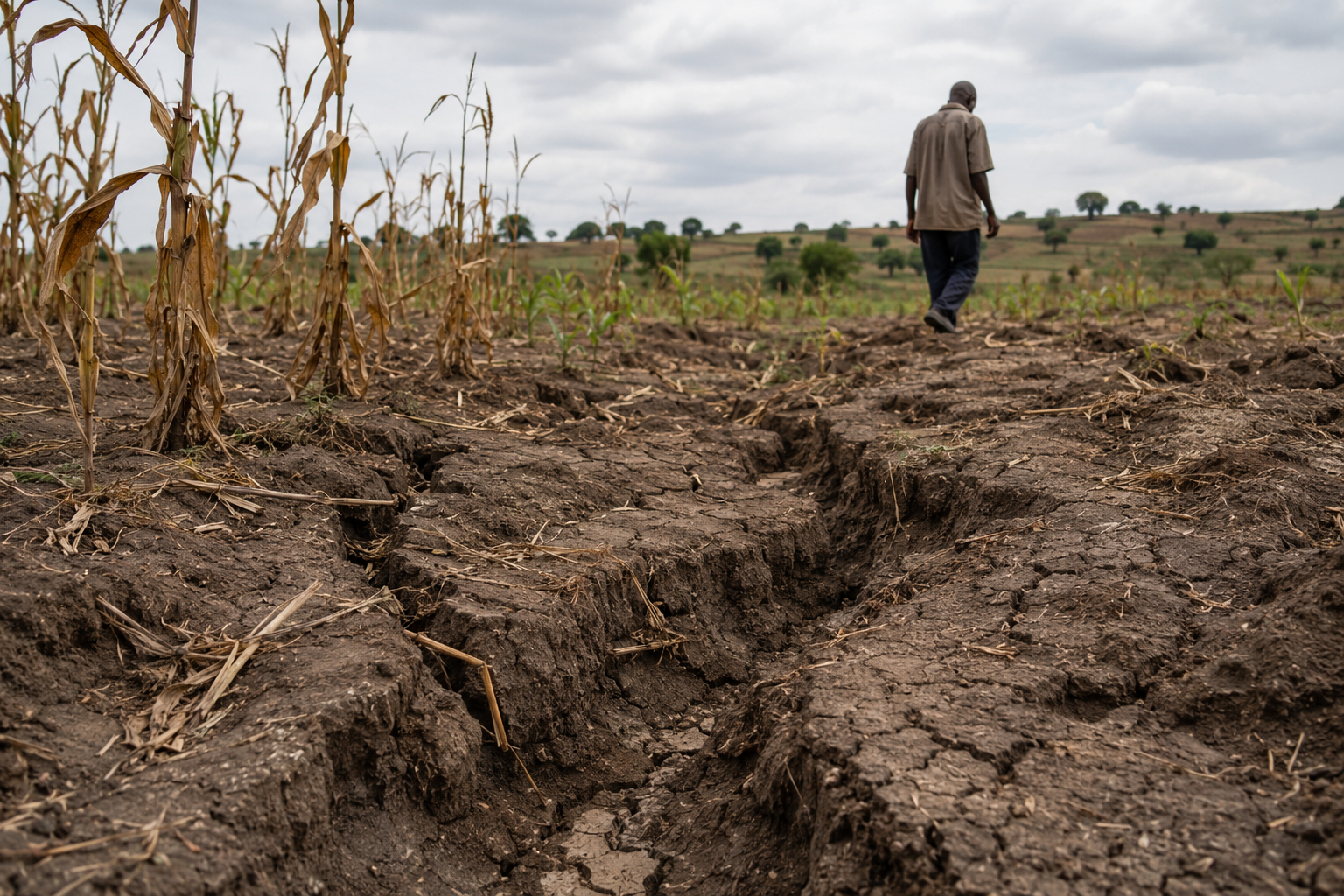
In Africa the chain starts with tired soil. The continent loses an estimated 30 to 60 kilograms of nutrients per hectare every year, a figure that drove the Nairobi Declaration at the 2024 Africa Fertilizer and Soil Health Summit. In Kenya, about 63 percent of arable land is acidic, according to KALRO's liming handbook, and acid soil locks up nutrients before a maize plant can reach them. A child's plate of ugali carries whatever that field could give it. Agrihealth simply proposes that we measure it.
What the stack looks like in practice
The First Thirty's portfolio reads like a relay team, each company handing data to the next.
- Mapana monitors soil health, so a farm knows what its crops are drawing on.
- Antler Bio reads gene activity in dairy cows to show how feed and housing are affecting their health and milk.
- Edacious measures what is actually in the milk, meat, grain, or vegetable at the end, at a fraction of the old laboratory price. It raised $8.1 million in February 2026.
- Cerve puts AI agents inside food businesses so the information moves rather than sits in a spreadsheet.
Together they can show that better soil produced a better crop, that the crop produced a healthier animal, and that the animal produced a measurably better product. The farm that did the work can then charge for it. The firm calls this outcome a service, and it is the business model it expects to win.
The idea reaches past the farm gate. Yousefian argues that food benchmarking could replace certification. Instead of a label that says "organic," a shopper, or their shopping assistant, could see how a carton of milk compares to every other carton on measured nutrients. Claims about omega-3 or vitamin C would be checked against a report rather than taken on trust.
Where the money is going
Agrihealth arrives at an unusual moment for agricultural technology investment.
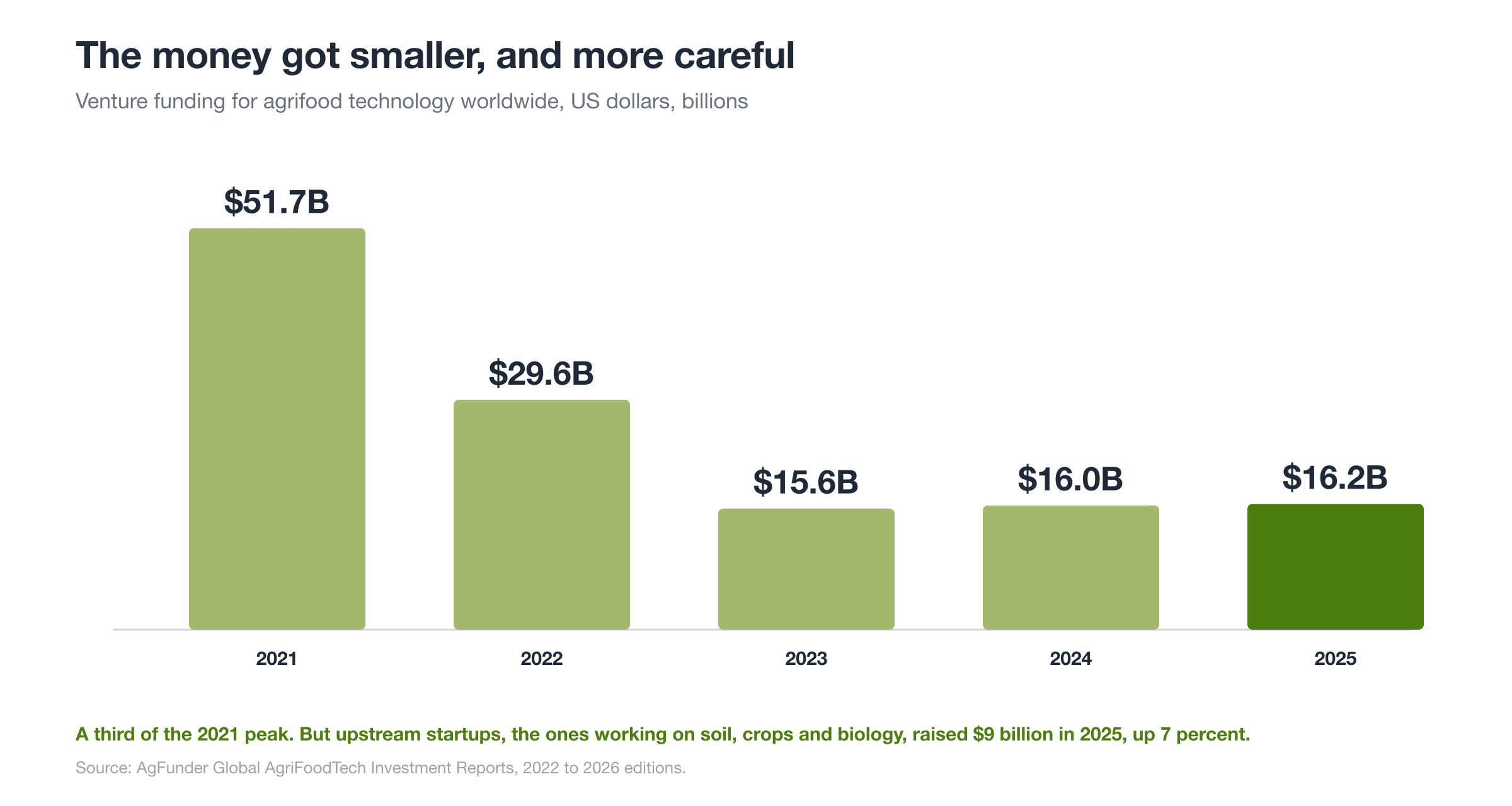
Venture money for agrifood technology peaked at $51.7 billion in 2021 and has settled near $16 billion a year since 2023, according to AgFunder. What has changed is the mix. Money for grocery delivery apps has dried up, while upstream companies working on soil, crops and biology raised $9 billion in 2025, up 7 percent. Nearly a third of all deals now go to deep science. Investors want data and measurable outcomes, not growth at any cost.
That suits a fund selling measurement. It also opens exits beyond the usual agribusiness buyers. Apple, Google and Amazon have all built health platforms hungry for food data, and AI companies have started buying biology firms because their models are only as good as what they are trained on.
The honest objections
Agrihealth still has to answer hard questions. The link from soil to human health is plausible and partly measured, but it has not been proven at scale. A carrot with 10 percent more zinc does nothing for a child who eats no carrots. And benchmarked food could easily become a premium product for wealthy shoppers, leaving the people with the worst deficiencies untouched.
Yousefian concedes one gap outright: the fund has no plant breeding company. If the goal is to change what is in staple crops like maize, rice and wheat, breeding may matter more than any sensor, and the firm says it is looking.
What it means for farmers
Strip away the venture language and the message for a farmer in Uasin Gishu is the same as for one in Iowa. Food is about to be measured, and measured food can be priced on quality rather than weight alone.
The farmers who benefit first will be the ones with records. Know what your soil holds, what you applied and what you harvested. A soil test is the cheapest first entry in that ledger. Keep it, and when a buyer or a benchmark comes asking what your food ate, you will be able to answer.