Rising fuel prices are one of those quiet pressures that slowly eat into a farm's profitability. Whether driven by geopolitical instability, supply chain disruptions, or shifting energy markets, the cost of diesel — particularly off-road farm diesel — tends to climb faster than most producers can adjust. And unlike input costs that are locked in at the start of a season, fuel is a moving target that touches nearly every operation on the farm.
So how do you take control of something that feels largely out of your hands?
The answer begins not at the fuel pump, but at the planning table.
Start With What You Can Control
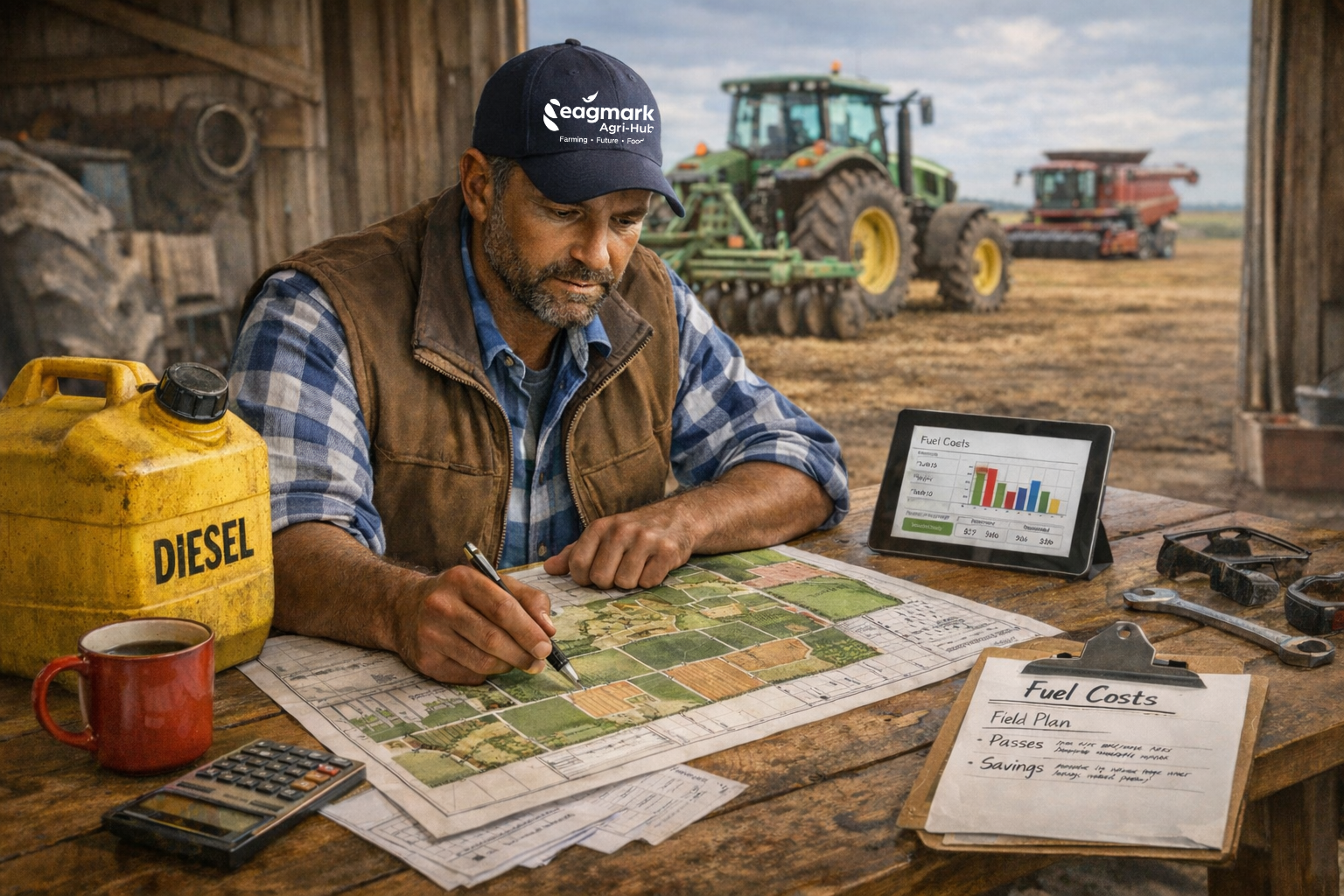
Field-level planning is one of the most practical — and often underused — strategies for managing fuel expenses. Rather than reacting to price spikes after the fact, this approach works by mapping out the specific field operations required for each crop, then identifying where fuel is actually being consumed.
It sounds simple, but the exercise often surfaces surprising inefficiencies. Many farms carry forward the same tillage passes, cultivation routines, and equipment pairings year after year without questioning whether each step is still necessary.
A few honest questions can go a long way:
Are there field operations that were once essential but are now more habit than necessity?
Can any passes be combined or eliminated altogether?
Is the equipment being used well-maintained and running efficiently?
Even modest reductions — skipping a single tillage pass or combining two operations into one — can translate into meaningful fuel savings across hundreds of acres.
Soil Type Matters More Than You Think
One factor that is frequently overlooked in fuel budgeting is soil variability. Heavier clay soils demand significantly more engine power to work through than lighter sandy loams. A tillage pass that burns four litres per hectare in one field might consume six or more in the next, simply because of soil composition.
Accounting for this variability when estimating fuel use gives a far more accurate picture of true production costs — and helps prioritize which fields benefit most from reduced tillage or no-till approaches.
The Tractor Question
There is a common assumption that switching to a smaller tractor will automatically save fuel. In practice, the math is rarely that straightforward.
Smaller tractors do consume fewer litres per hour, but they also take longer to cover the same ground. When you calculate fuel use per hectare rather than per hour, the difference between a smaller and larger tractor often narrows considerably. The real variable is not tractor size — it is the operation itself.
What does make a measurable difference is tractor condition. An older machine, or one that has been poorly maintained, can consume ten percent or more additional fuel compared to a well-serviced equivalent. Routine maintenance — clean filters, proper tyre inflation, well-tuned engines — is one of the simplest and most cost-effective fuel-saving measures available.
A Practical Framework
For any farmer looking to get ahead of rising fuel costs, the approach can be distilled into a few steps:
List every field operation planned for each crop this season.
Estimate fuel consumption per operation, adjusted for soil type and field conditions.
Challenge each operation — is it necessary this year, or is it carried forward from past practice?
Evaluate equipment condition — are maintenance issues inflating fuel use?
Look for combinations — can two passes become one?
This kind of planning does not require sophisticated software or expensive consultants. It requires a willingness to look at the familiar with fresh eyes and ask whether the way things have always been done is still the best way to do them.
The Bigger Picture
Fuel is not just a line item. It is woven into the cost of every bushel harvested, every bale rolled, and every load transported. When fuel costs rise, they ripple through the entire operation. But the farms that weather these fluctuations best are not necessarily the ones with the deepest pockets — they are the ones with the sharpest plans.
In a world where energy prices are increasingly unpredictable, the most valuable fuel-saving tool on any farm is not a new tractor or a cheaper supplier. It is a well-thought-out plan.