A Global Guide for Smallholder Farmers and Commercial Operations
The Global Challenge
Insect pests destroy stored grain worth billions annually. In sub-Saharan Africa, losses reach 20-40% of harvested grain. ASEAN countries lose an average of 23% across the value chain. In temperate regions with better infrastructure, losses average 5-10%. Regardless of location, the principle remains consistent: prevention costs far less than remediation.
Traditional storage structures‒woven baskets, mud granaries, polypropylene sacks‒cannot adequately protect grain from insects and rodents. Many smallholder farmers are forced to sell immediately after harvest when prices are lowest, then buy back grain months later at premium prices. This "poverty trap" affects millions of farming households across Africa, Asia, and Latin America.
Understanding Storage Pests
Primary Pests (Internal Feeders)
These insects penetrate intact kernels. Weevils‒the maize weevil (Sitophilus zeamais) in tropical regions and the rice weevil in temperate zones‒bore into grain where larvae hollow out kernels from within. The larger grain borer (Prostephanus truncatus), particularly devastating in Africa, can reduce grain weight by 34% and damage 80% of stored maize. The cowpea weevil (Callosobruchus maculatus) devastates legume stores throughout the Sahel.
Secondary Pests (External Feeders)
External feeders exploit damaged kernels, dust, and debris. Flour beetles, sawtoothed grain beetles, and Indian meal moths thrive on broken grain and fines. These pests indicate poor grain quality at storage‒clean grain with minimal damage resists secondary infestations.
Universal Prevention Principles
Whether you farm one hectare or one thousand, the SLAM framework applies: Sanitation, Loading, Aeration (where possible), and Monitoring.
Sanitation
Old grain residues harbour insect populations that quickly infest new harvests. Before storing new grain, remove all residual grain from storage structures, sweep or vacuum cracks and crevices, and repair any holes that allow pest entry. In traditional granaries, replace damaged wooden components that may shelter insects. For metal bins, clear residue from seams and under-floor areas.
Moisture Management
Proper drying is non-negotiable. For most cereals, target moisture content below 13-14% before storage. At 18% moisture or higher, grain deteriorates within days. In humid tropical regions where sun-drying is difficult during harvest season, delayed drying remains a primary cause of loss. Where possible, thresh immediately after harvest and begin drying within 24 hours.
Temperature Control
Most storage insects originated in tropical climates and require warmth to reproduce. Insect activity virtually ceases below 15°C (59°F), and insects become dormant below 10°C (50°F). In temperate regions with cold winters, cool grain to 4-6°C (40-43°F) for long-term storage. In tropical regions where cooling is impractical, hermetic storage a method of preserving agricultural commodities by storing them in airtight, moisture-proof containers that create a "modified atmosphere"‒ becomes essential.
Enroll in the Good Agricultural Practices Course
Storage Solutions by Scale and Context
Smallholder Farmers: Hermetic Bags
For farmers storing 50-500 kg, hermetic (airtight) bags offer the most cost-effective protection. These triple-layer bags‒two high-density polyethylene liners inside a woven polypropylene sack‒create an oxygen-depleted environment. Insects inside the sealed bag consume available oxygen and die within weeks. Research across Kenya, Zimbabwe, Ghana, and Niger confirms these bags reduce storage losses to under 1%, compared to 30-40% in traditional sacks.
Key requirements for hermetic bags: Grain must be dried below 13% moisture before sealing. Bags can be reused for 3-4 seasons if undamaged. Control rodents separately, as they can puncture liners. Bags cost approximately $2-3 USD and protect grain for 6-12 months without chemicals.
Small-Scale Farmers: Metal Silos
For farmers storing 100-3,000 kg, metal silos provide durable, hermetic storage. These cylindrical galvanized steel structures, promoted by FAO across Africa, Asia, and Latin America, eliminate insect losses through oxygen depletion while excluding rodents. A 1,000 kg silo can preserve enough grain to feed a family of five for one year. Initial costs ($35-375 USD depending on capacity) are offset by near-zero storage losses. Trained local artisans can fabricate these silos, creating employment while addressing food security.
Commercial Operations: Aerated Bins and Silos
Large-scale operations with steel bins should install aeration systems to manage temperature. Cool grain to below 15°C (59°F) within two weeks of harvest to prevent insect reproduction. By December (in temperate Northern Hemisphere regions), target 5°C (41°F) to kill adult insects and prevent mites. Run aeration fans when ambient temperature is 4-6°C below grain temperature. Level grain surfaces and avoid overfilling to ensure uniform airflow.
Monitoring and Early Detection
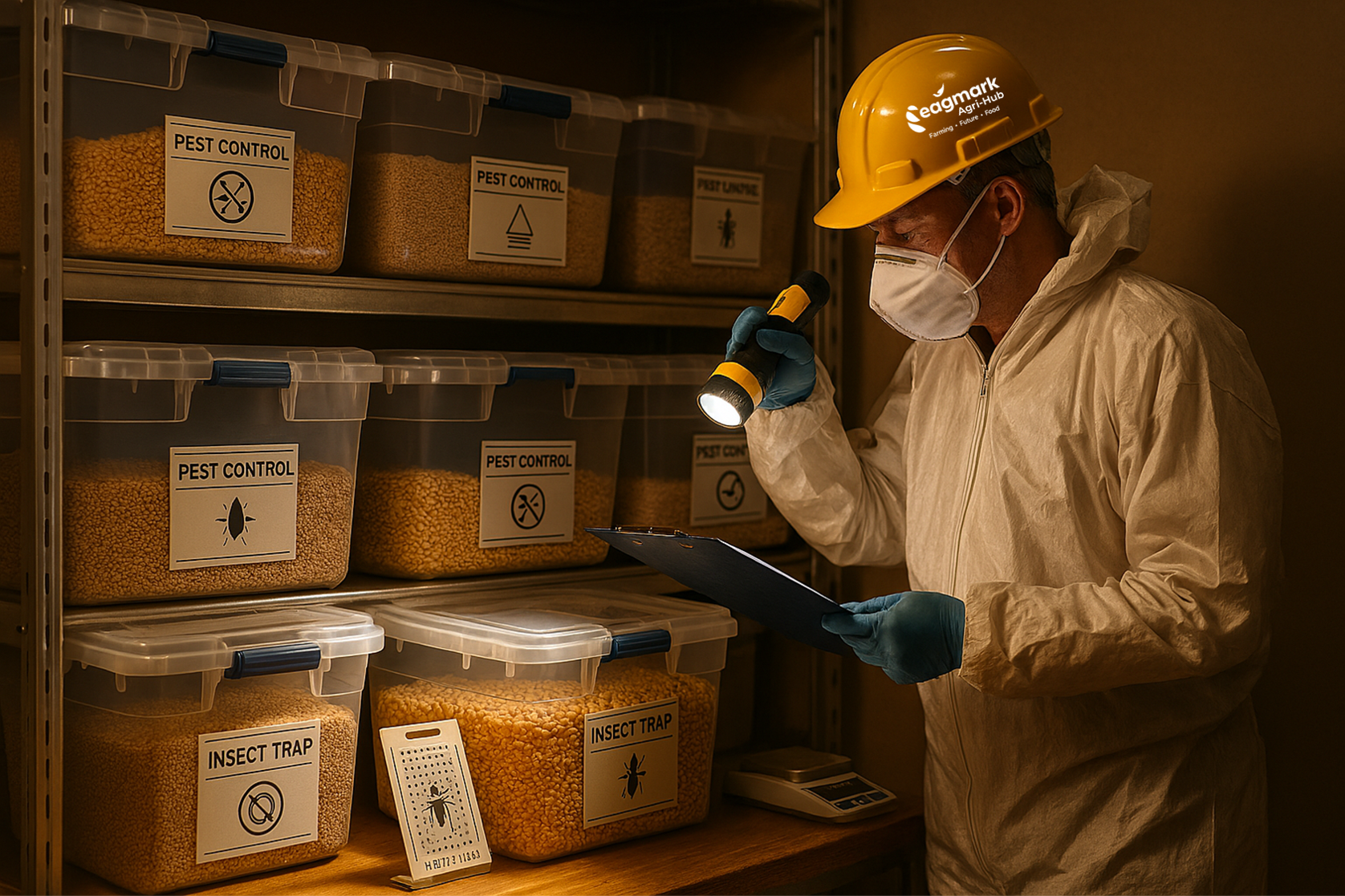
Regular inspection catches problems before they escalate. For aerated bins, inspect weekly when grain exceeds 13°C (55°F); every two weeks when cooler. Sample from multiple locations—center, near walls, and surface. Rising temperature indicates biological activity. For hermetic storage, check seals for damage and watch for pest entry points. In traditional structures, look for webbing (moth larvae), powder (beetle boring), and emergence holes.
Regional Considerations
Tropical Humid Regions
High temperatures year-round mean insects reproduce continuously. Aeration-based cooling is ineffective—hermetic storage is essential. Drying grain adequately before storage is the primary challenge; where mechanical dryers are unavailable, prioritize prompt harvest and immediate sun-drying during dry spells.
Temperate Regions
Cold winters provide natural pest control—use this advantage. Time harvest appropriately, cool grain as temperatures drop, and maintain cool conditions into spring. The critical period is late spring through summer when warming grain reactivates dormant populations.
Rice Storage
Rice presents unique challenges. Storing as rough rice (paddy) rather than milled rice provides natural protection—the hull resists insect and fungal attack. Dry to 14% moisture within 24 hours of harvest for safe storage. Parboiled rice, common in South Asia and parts of Africa, resists storage pests better than raw rice.
Taking Action
Effective grain storage requires matching technology to context. A Kenyan smallholder and a Canadian commercial farmer face different constraints but identical principles: start clean, store dry, exclude oxygen or maintain cold, and monitor regularly. The technologies exist—from $2 hermetic bags to sophisticated temperature monitoring systems. Implementation requires investment, training, and consistent practice. The return is straightforward: grain that feeds families and generates income rather than feeding insects.