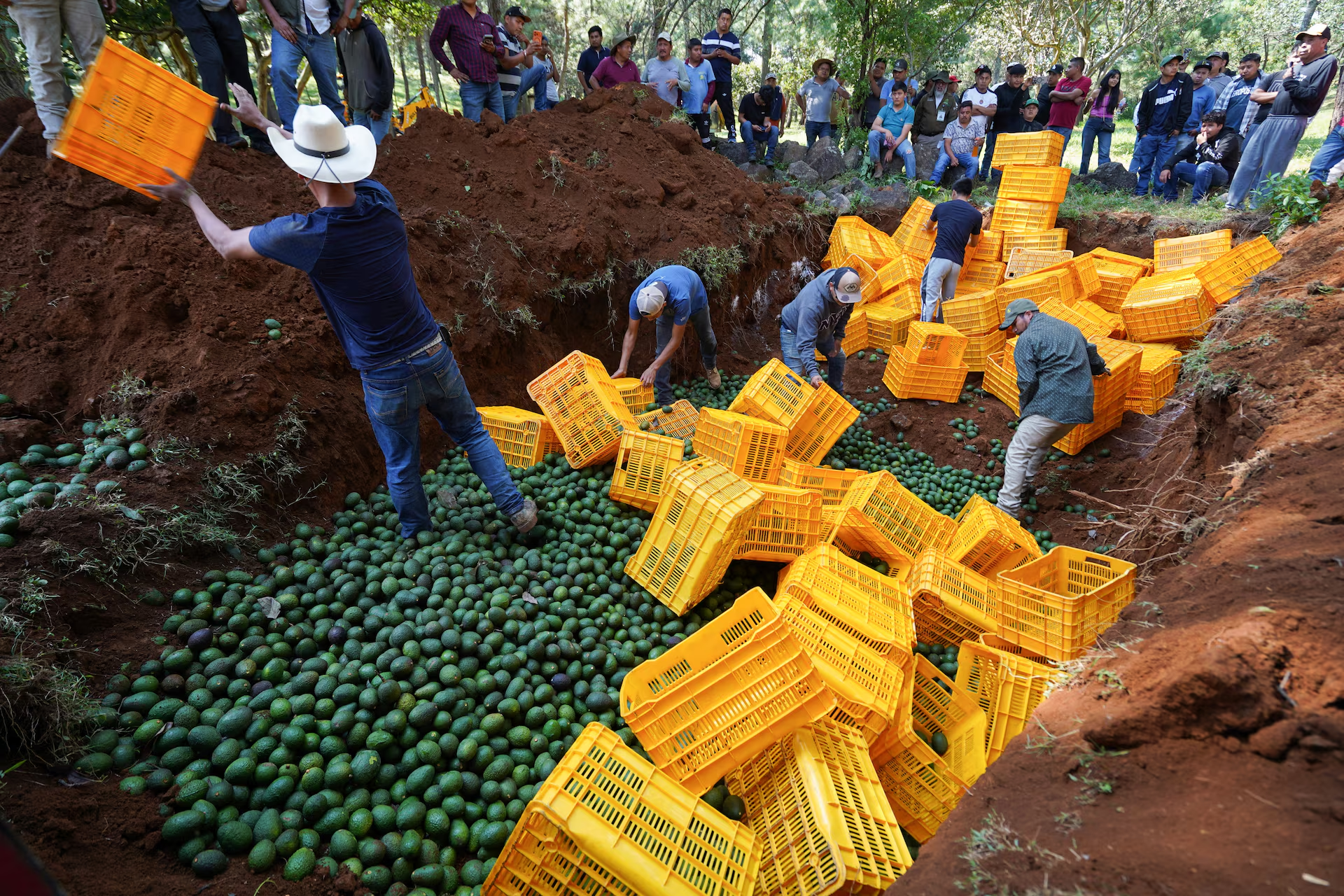
On the last weekend of October, in the hills around Ziracuaretiro in the Mexican state of Michoacán, trucks backed up to freshly dug trenches. Workers on top of the loads passed down yellow crates full of green Hass avocados and tipped them into the pit. The fruit was covered in lime and then soil. Across Michoacán, Jalisco, Colima and Nayarit, growers got rid of up to 52 tonnes of avocados this way, and some loads were burned.
None of this fruit was rotten. Most of it would have looked fine on a supermarket shelf. It was destroyed because inspectors found the larvae of the avocado seed weevil inside fruit meant for export.
Michoacán's environment minister, Alejandro Méndez, confirmed the find and said the affected fruit never reached the market. Mexico's plant health agency, Senasica, oversaw the disposal, and state officials and Senasica held back shipments while they work out when exports can restart. No one has yet put a figure on the losses.
"So that the fruit cannot be exported"
A grower filmed by Reuters at one of the pits explained the logic in plain terms. Burying the fruit, he said, is one of the rules plant health authorities set so that infested fruit cannot leave the country. If borers turn up in the fruit or on a tree's branches, producers are not allowed to ship to the United States.
He was also angry. In his view, the pest had been found not only in local orchards around San Ángel Zurumucapio but in fruit coming in from other states. He pointed to a report from Peribán, another growing town, of weevils found in avocado seeds that he believed had come from Nayarit. That kind of fruit, he said, is damaging the name Michoacán has built for its exports.
That complaint matters, because in export farming a reputation is shared. One careless lot can close the door for everyone. Not every account agrees on the details yet. One report quotes a growers' union saying the pest was only suspected and had not been formally diagnosed. Officials have not named the exact weevil species in public.
One buyer, one door
To see why growers would bury good-looking fruit rather than take the risk, look at where Mexican avocados go.
Mexico grows close to 28% of the world's avocados. In 2025 it harvested about 2.7 million tonnes and exported 1.22 million tonnes. Of that, 1.08 million tonnes went to the United States, according to the USDA Foreign Agricultural Service. Only two states, Michoacán and Jalisco, are cleared to ship to the US, and together they grow about 85% of the crop.
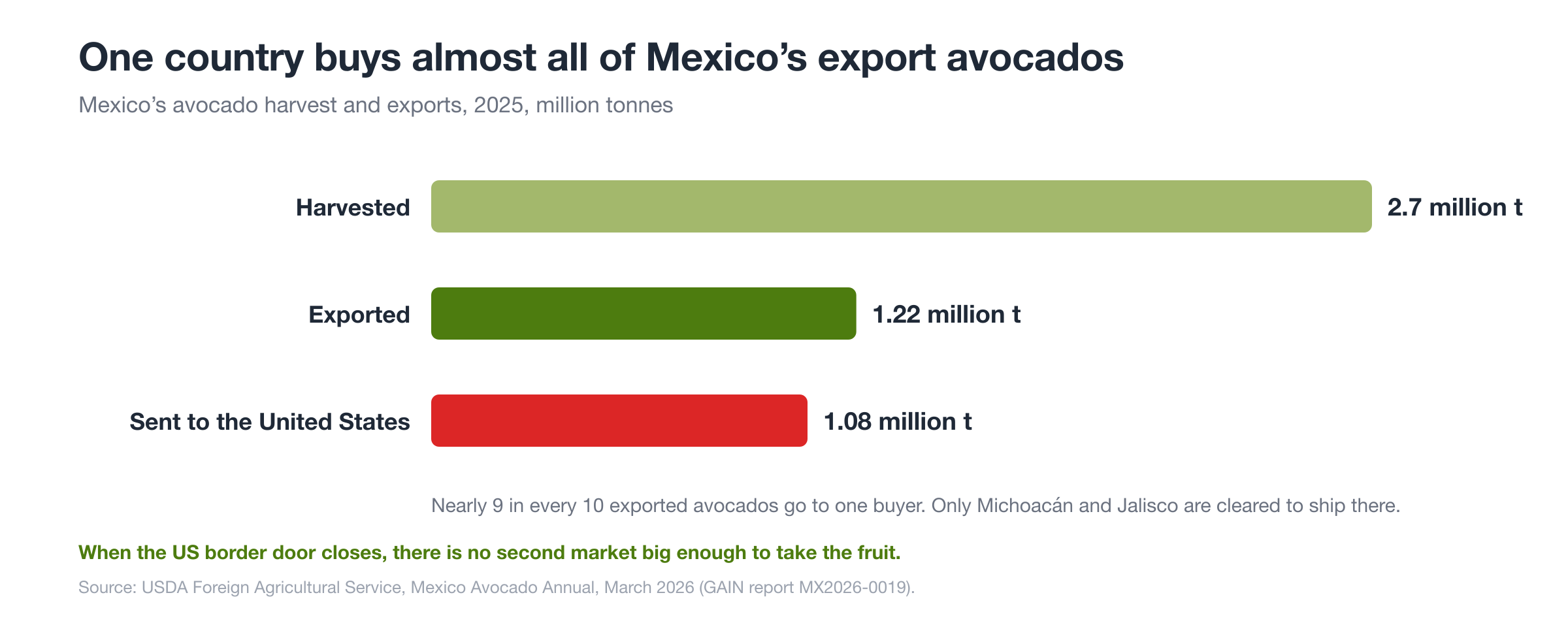
When nearly nine in every ten export avocados go to one buyer, that buyer's rules are, in practice, the rules of the whole industry. A grower who loses access to the US has no other market large enough to absorb the fruit at anything like the same price.
A pest older than the trade
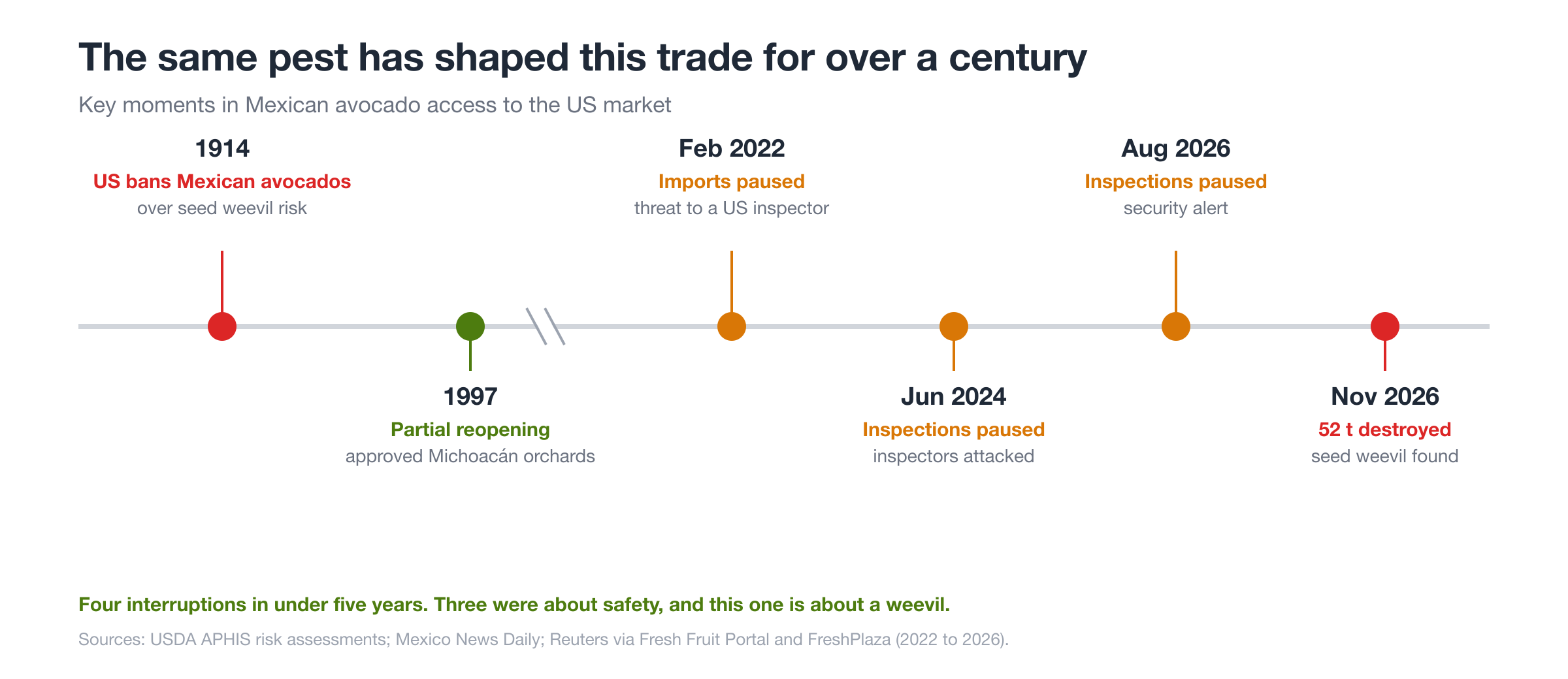
The seed weevil is not a new worry. The US banned Mexican avocados in 1914, and one of the main reasons was a seed weevil. The door only partly reopened in 1997, when[USDA risk assessments allowed Hass avocados from approved orchards in Michoacán, under a system of orchard surveys, inspections and packhouse checks that still shapes the trade today. Seed weevils are still on the list of pests that system is built to keep out.
The trade has had a rough few years. US inspectors paused their work in Michoacán in February 2022 after one of them was threatened, again in June 2024 after inspectors were attacked, and again in August 2026 after a security alert. Those pauses were about the safety of the people doing the checks. This one is about the very pest that kept Mexican avocados out of the US for most of the 20th century.
It also lands at a bad moment for small growers. According to The Rio Times, many small producers in Michoacán stopped cutting fruit on 23 October in protest at farm-gate prices of around 15 pesos a kilo, well short of the roughly 40 pesos they say they need.
Why this pest is so hard to catch
What makes the seed weevil so troublesome is where it lives. According to Senasica's guidance, the female lays one or two eggs in each fruit. They hatch in 12 to 14 days. The larvae then feed on the flesh and the seed for about two months before turning into pupae inside the seed itself. The adult weevil can also bore into branches and trunks, and it spreads quickly through an orchard.
Through all of this, the skin of the fruit shows no damage. You only find the problem by cutting the avocado open, which is exactly what the growers in the video were doing as they sorted crates by the roadside.
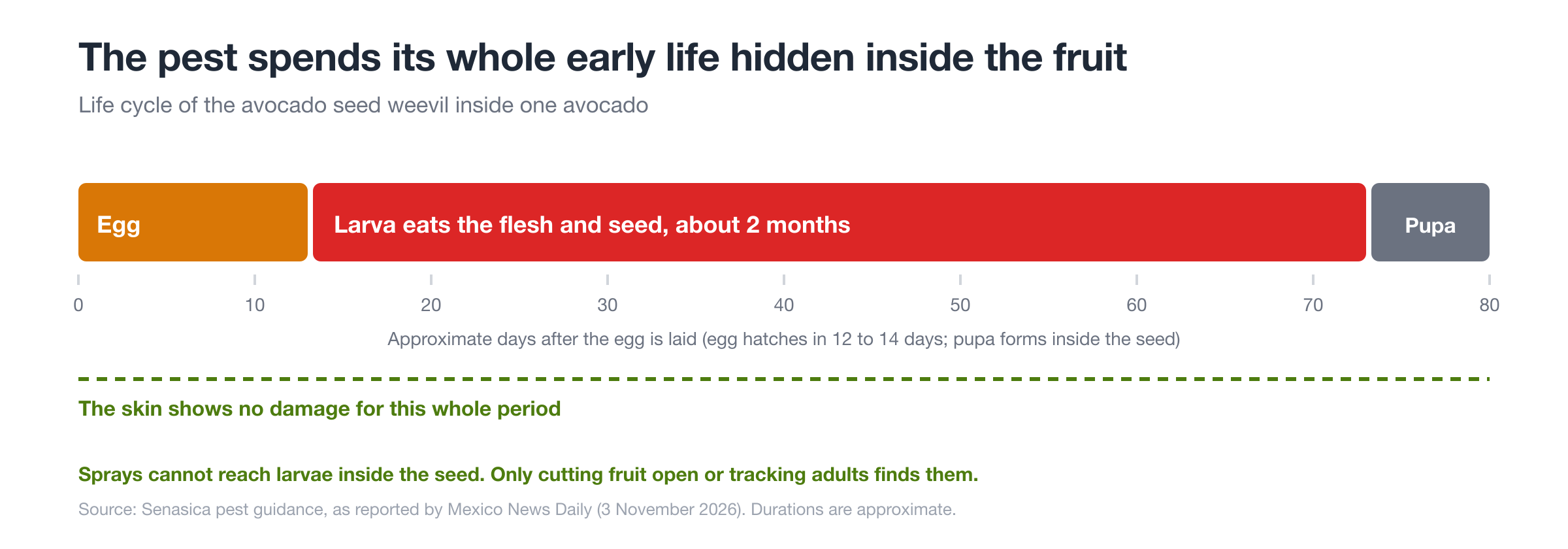
This is also why insecticides do little once the fruit is infested. A spray cannot reach a larva sealed inside a seed. Chemical control only works on adults as they come out, and by then the damage is done.
What any avocado grower can take from this
Seed weevils are found in Mexico and parts of Central and South America, not in every growing region. But the lesson applies to any farmer selling fruit across a border, whether the pest is a weevil in Michoacán or a fruit fly or moth somewhere else. Importing countries do not judge a farm by how its fruit looks. They judge it by what their inspectors find inside.
A few habits make the difference.
Cut before you ship. Open a sample of fruit from every block before it leaves the farm. It costs a few avocados and can save a whole consignment.
Clean up fallen fruit. Infested fruit left on the ground is where the next generation hatches. Senasica's advice is to bury damaged fruit at least one metre deep or burn it, so the insects inside cannot come out.
Scout the trees, not just the fruit. Look for boring damage on branches and trunks, and for adult beetles, which are the only stage sprays can reach.
Use biological control where you can. Fungi that infect insects, such as Beauveria bassiana, are one of the options Senasica lists for keeping adult numbers down without relying only on chemicals.
Keep records that trace every crate. The grower in Ziracuaretiro was angry because he believed fruit from elsewhere was being passed off under his region's name. Lot records that link each crate to an orchard protect honest farmers. When a pest turns up, the problem can be traced to one source instead of closing a whole region.
Fifty-two tonnes is a small share of a crop measured in millions. The real cost is the trust that lets the rest of that crop cross the border. Mexican growers chose to bury good-looking fruit to protect it, and farmers elsewhere would be wise to see it the same way.