In the first days of March 2026, ships stopped moving through the Strait of Hormuz. Most farmers never noticed the headline. They noticed the invoice.
That narrow stretch of water carries close to half of the world's seaborne sulfur, a yellow by-product of oil refining that turns phosphate rock into fertilizer. It also carries roughly a quarter of the world's exported nitrogen fertilizer and a tenth of its phosphates, according to the World Trade Organization. When the strait closed, the shock reached Kitale, Mato Grosso and Punjab within weeks.
Six months on, the picture has split in two. Nitrogen has recovered. Phosphate has not. And potash, quietly, has become the cheapest nutrient on the market.
The round trip that never happened
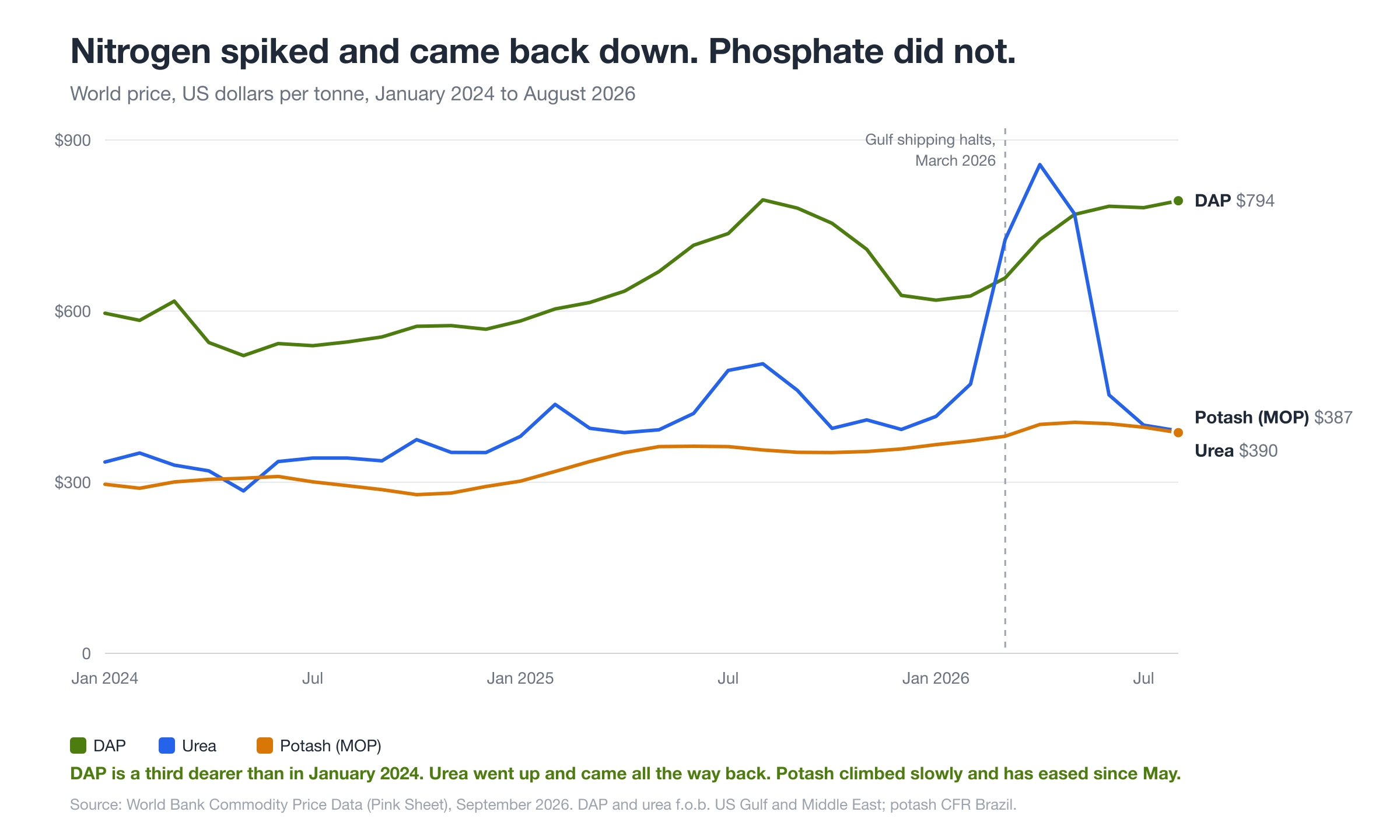
Urea tells the simple story. It jumped from about $470 a tonne in February to $857 in April, then fell all the way back to $390 by August as Gulf cargoes found new routes and buyers stepped away, according to the World Bank's monthly price data.
DAP, the workhorse phosphate fertilizer, went up with it and stayed there. It ended August at $794 a tonne, a third more than in January 2024. Indian buyers were paying $895 to $915 a tonne delivered in September, and the country's DAP imports for January to July were 23 percent below the year before, reports the International Fertilizer Development Center.
The reason phosphate did not come back down is a raw material that never appears on a fertilizer bag.
The sulfur problem
Making phosphate fertilizer takes sulfuric acid, and a lot of it. Sulfur is not mined for its own sake. It comes out of refineries and gas plants as a by-product, so when demand jumps, supply cannot follow. A large share of it comes from the Gulf.
At the same time, the fertilizer industry is no longer the only buyer. Copper and nickel refiners need sulfuric acid. So do the factories making lithium iron phosphate batteries. China restricted sulfur and phosphate exports in mid-March to protect its own farmers and, as Fertilizer Daily reported, extended those curbs through August. China mines 44 percent of the world's phosphate rock, according to the US Geological Survey, so when it stops exporting, everyone else feels it.
The Mosaic Company, one of the largest phosphate producers, gave a rare look at what this did to its own costs.
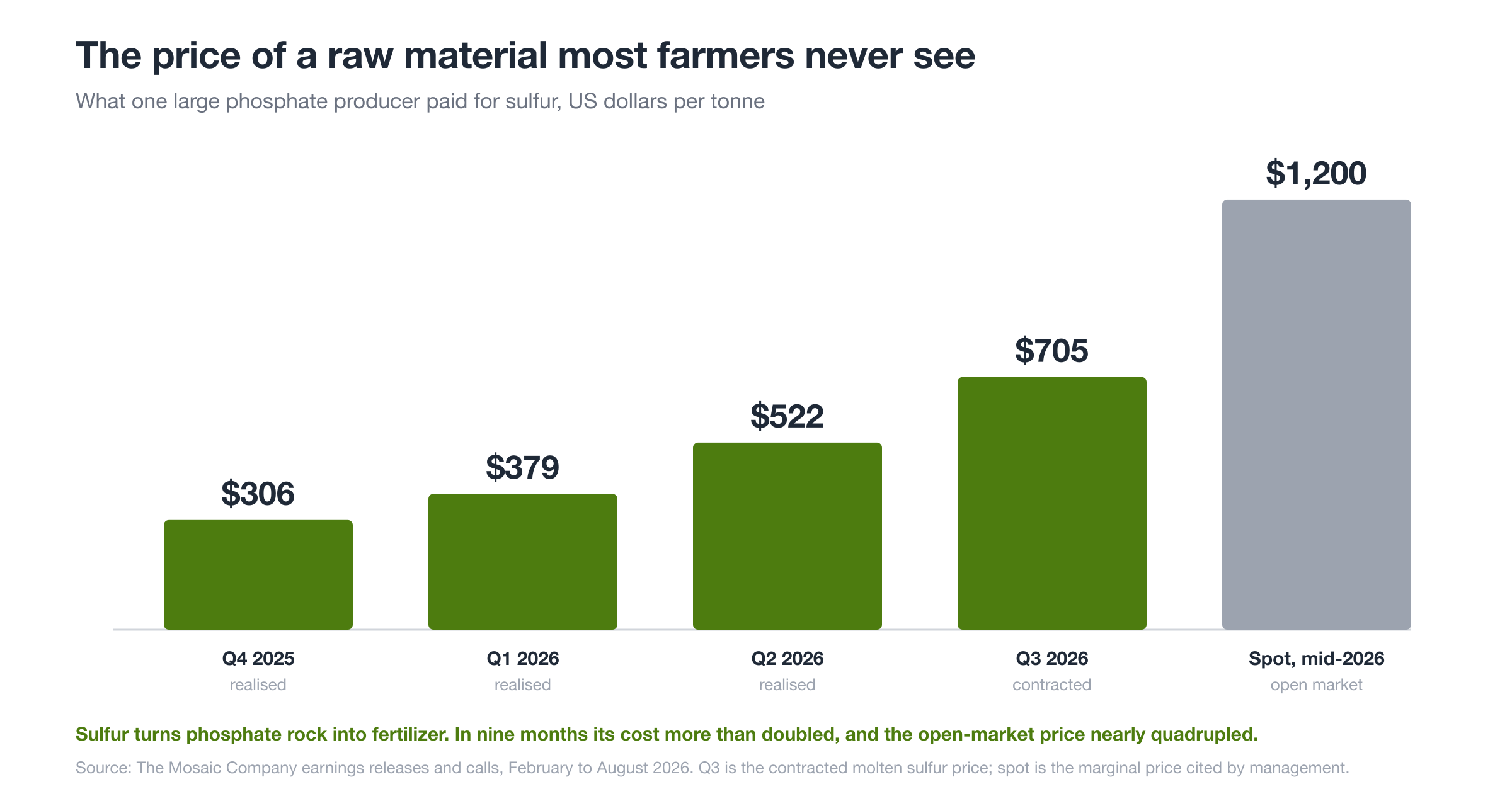
Faced with spot sulfur at $1,200 a tonne, Mosaic halved output at two US plants and idled operations in Brazil rather than make fertilizer at a loss. It was not alone. Argus expects global phosphate fertilizer production to fall from nearly 69 million tonnes to under 60 million tonnes this year, with consumption down about 13 percent. Mosaic's own estimate of the global shortfall runs as high as 30 million tonnes.
Prices in China have cooled from their June peak, and Mosaic's management says it does not expect the sulfur squeeze to run into 2027. The World Bank pencils in a DAP decline of around 10 percent next year. Cheaper, then, but not cheap.
Potash is the odd one out
Potash lives in a different world. It is mined, not manufactured, and the big producers in Canada, Russia and Belarus are nowhere near the Gulf. Global output hit a record in 2024, Canadian exporters are on pace for another record year, and delivered prices in Brazil and Southeast Asia sat at $350 to $360 a tonne in September with comfortable stocks, according to the IFDCand DTN.
Here is the trap. Cheap potash cannot stand in for expensive phosphate. A crop grows only as well as its scarcest nutrient allows. Pour on potash and nitrogen while starving the plant of phosphorus and you have paid for fertilizer the crop cannot use.
The reverse mistake is just as costly. If you cannot afford your full phosphate rate, do not trim every other nutrient to match. That lowers the whole yield ceiling instead of one part of it.
The soil keeps score
What makes 2027 harder than 2026 is that many fields were already running on credit before the crisis began.
Farmers in Ghana, Kenya and Morocco have been cutting quantities, delaying purchases and shifting to lower-input crops, the African Plant Nutrition Institute found this year. In North America and Brazil, phosphate application is running about 30 percent below normal, according to Mosaic. In a single season this is a sensible response. Repeated for three or four seasons, it becomes a loan from the soil that has to be repaid with interest.

Every harvest removes nutrients. A five-tonne maize crop takes about 31 kilograms of phosphate and 18 kilograms of potash off each hectare, based on Ohio State University's field trials. A soybean crop removes far more potash. Replace less than that, year after year, and soil test levels fall until phosphorus, not rain or seed, becomes the thing holding back yield. The bill does not disappear. It gets bigger.
Governments are trying to soften the blow. Kenya's subsidised bag is set to fall to Sh2,000 from September, Pulse Kenya reports, and India is leaning on its import programme. Subsidies cover a fixed number of bags, though, and rarely the whole field.
Three moves before you plant
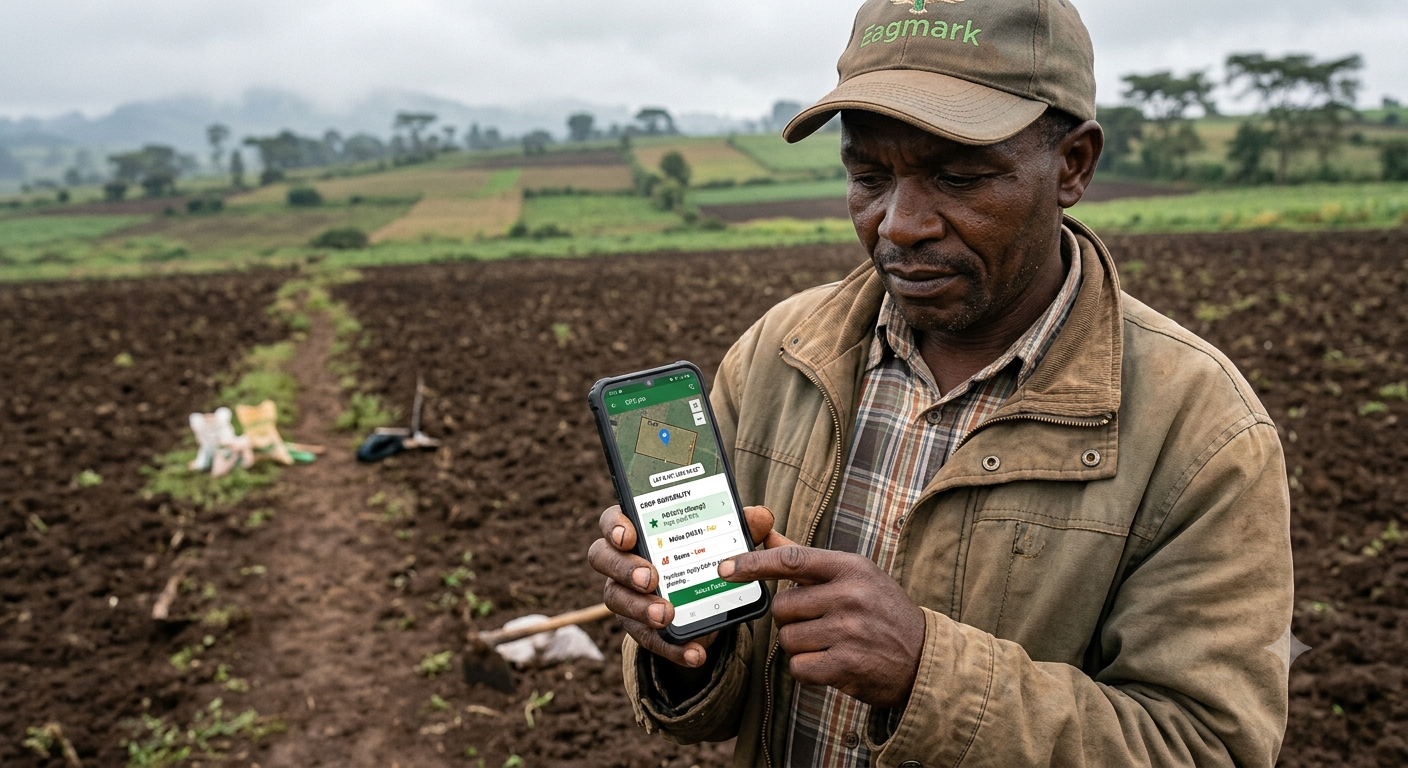
Test before you buy. A soil test costs less than a bag of DAP and tells you where the real gap is. Some fields have banked years of phosphorus and can coast for a season. Others cannot. Spend the expensive nutrient where the test says it is needed, and nowhere else. Eagmark's soil analysis service and fertilization planner are built for exactly this decision.
Buy the cheap nutrient now, place the dear one carefully. If potassium is low, this is the year to fix it, because potash may not stay this affordable. For phosphate, band or place it close to the seed rather than broadcasting. The crop gets more from every kilogram, and you buy fewer of them.
Use what the market cannot price. Manure, compost, crop residues and legumes in rotation all put phosphorus and potassium back without a shipping lane. Microbial products that free up phosphorus already locked in the soil are worth a trial, on part of a field, against a control strip. Ask for the evidence and then generate your own.
The Gulf will reopen, sulfur will fall back, and phosphate will get cheaper at some point in 2027. Your soil will not wait for that. It is keeping a ledger of every harvest and every skipped application, and it always collects.