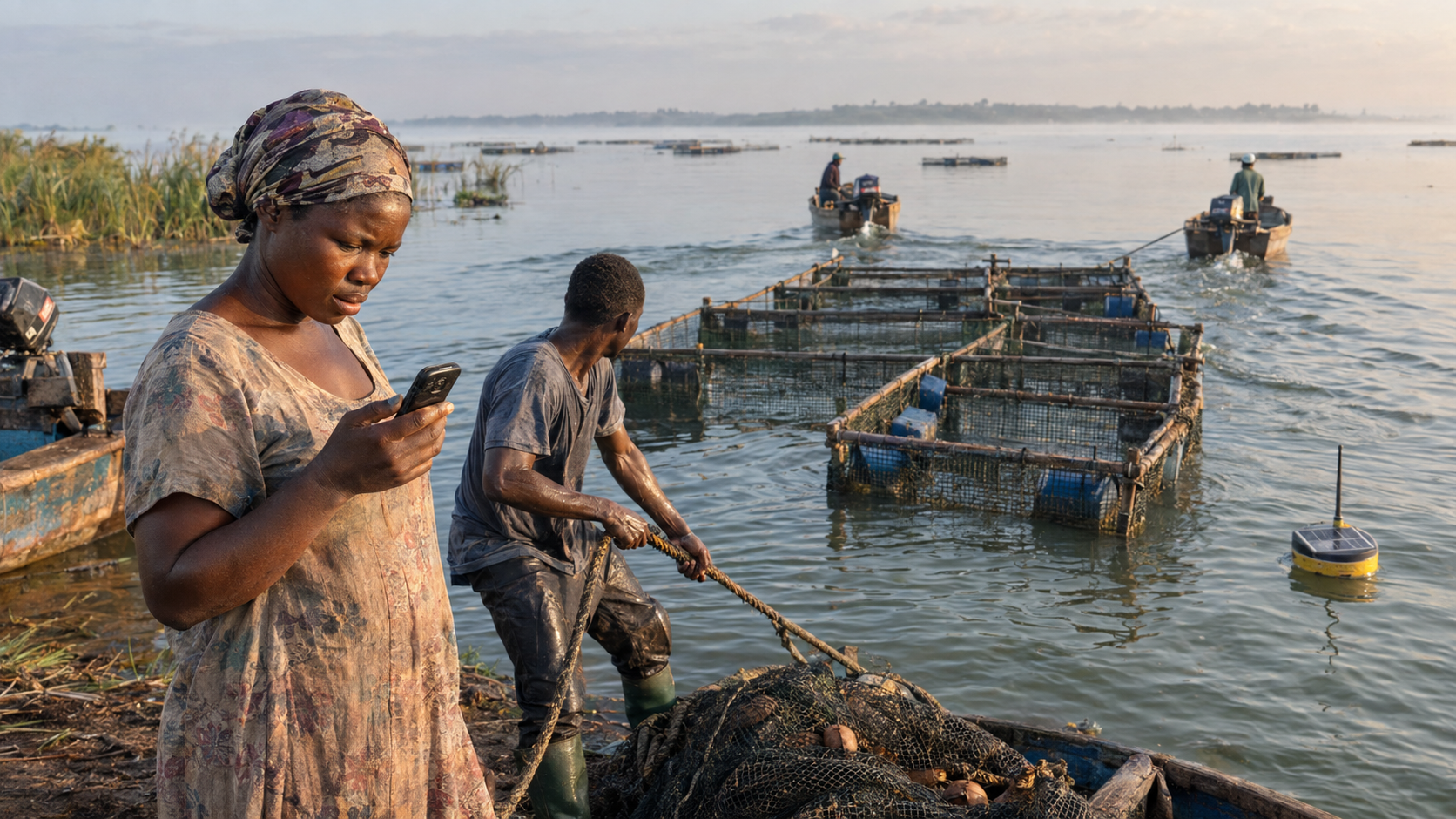
One morning in February 2026, a set of underwater sensors off Dunga Beach on Lake Victoria noticed the oxygen in the water sliding towards the level at which tilapia begin to die. A model trained on years of lake records recognized the pattern. Within hours, text messages went out to more than 300 cage farmers.
The farmers did the rest. Working the phones and WhatsApp groups, they towed more than 450 cages into deeper water. The two previous years had seen close to a million dollars of fish lost at that one beach to exactly this kind of oxygen crash, Mail & Guardian reported. Since the alert, there has been no mass die-off. The Kenya Marine and Fisheries Research Institute, which built the system with a Nairobi start-up, has already mapped 15 more high-risk sites.
It is a good story, and a true one. It is also the easy half of the question.
A fast-growing sector, about to be run by software
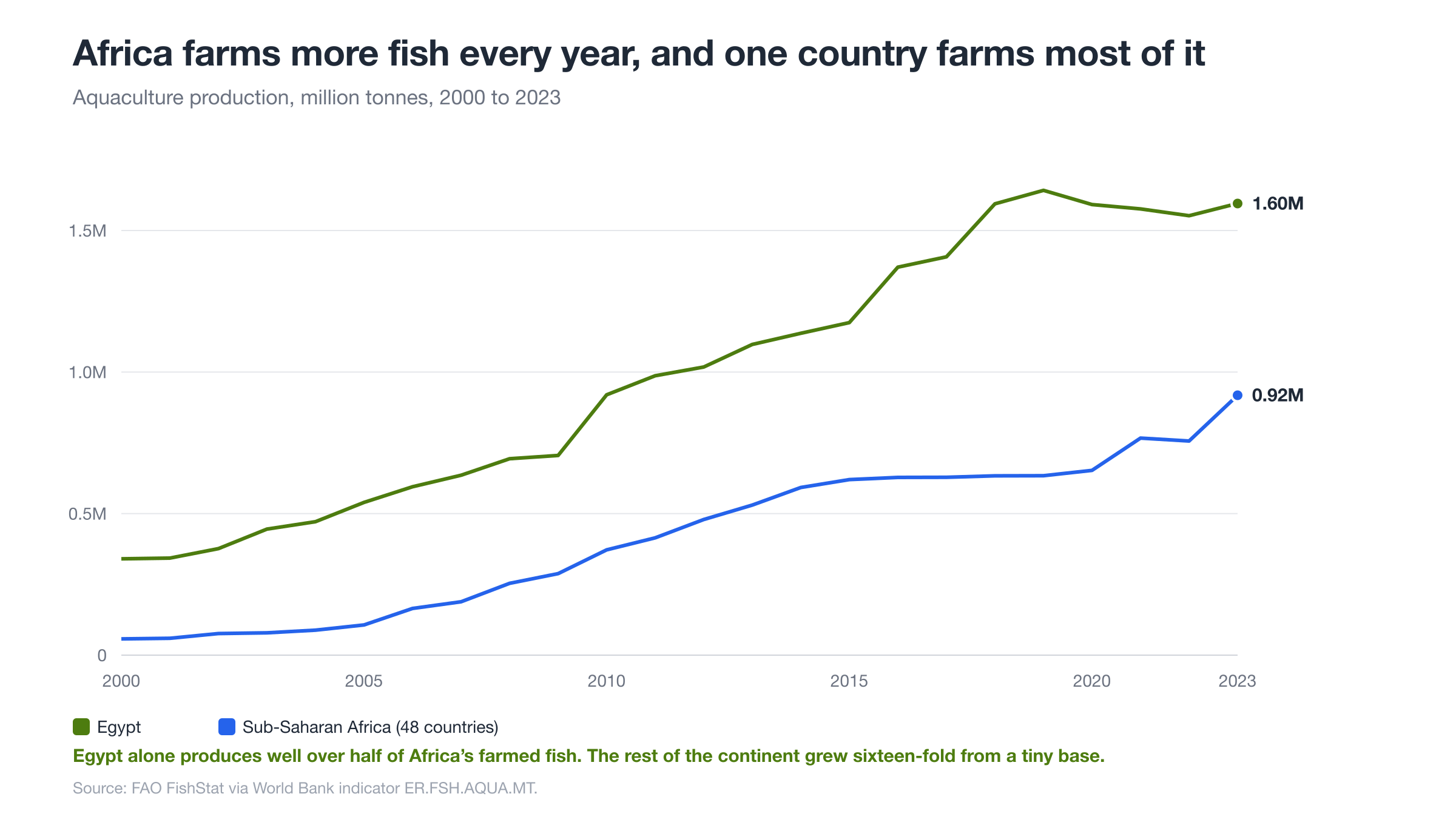
Africa farms more fish every year. Production reached 2.4 million tonnes in 2024, growing 8 percent a year since 2000 against a world average of 5, according to the FAO. Africans still eat less than half as much fish per person as the rest of the world, so the demand is there.
Sensors, satellites, and models will increasingly decide when cages are moved, which boats are watched, and where the next investment goes. The question is not whether the technology works. Dunga Beach shows it can. The question is who it works for.
Who got the text?
About 21 million women earn a living in small-scale fisheries worldwide, most of them in the work that happens after the boat lands: cleaning, smoking, drying, carrying, and selling, according to a study in Nature by the FAO, WorldFish, and Duke University. On a Lake Victoria beach at dawn, the person deciding whether to buy the morning's catch is very often a woman with a phone in her hand.
Whether that phone can receive the warning is a different matter.
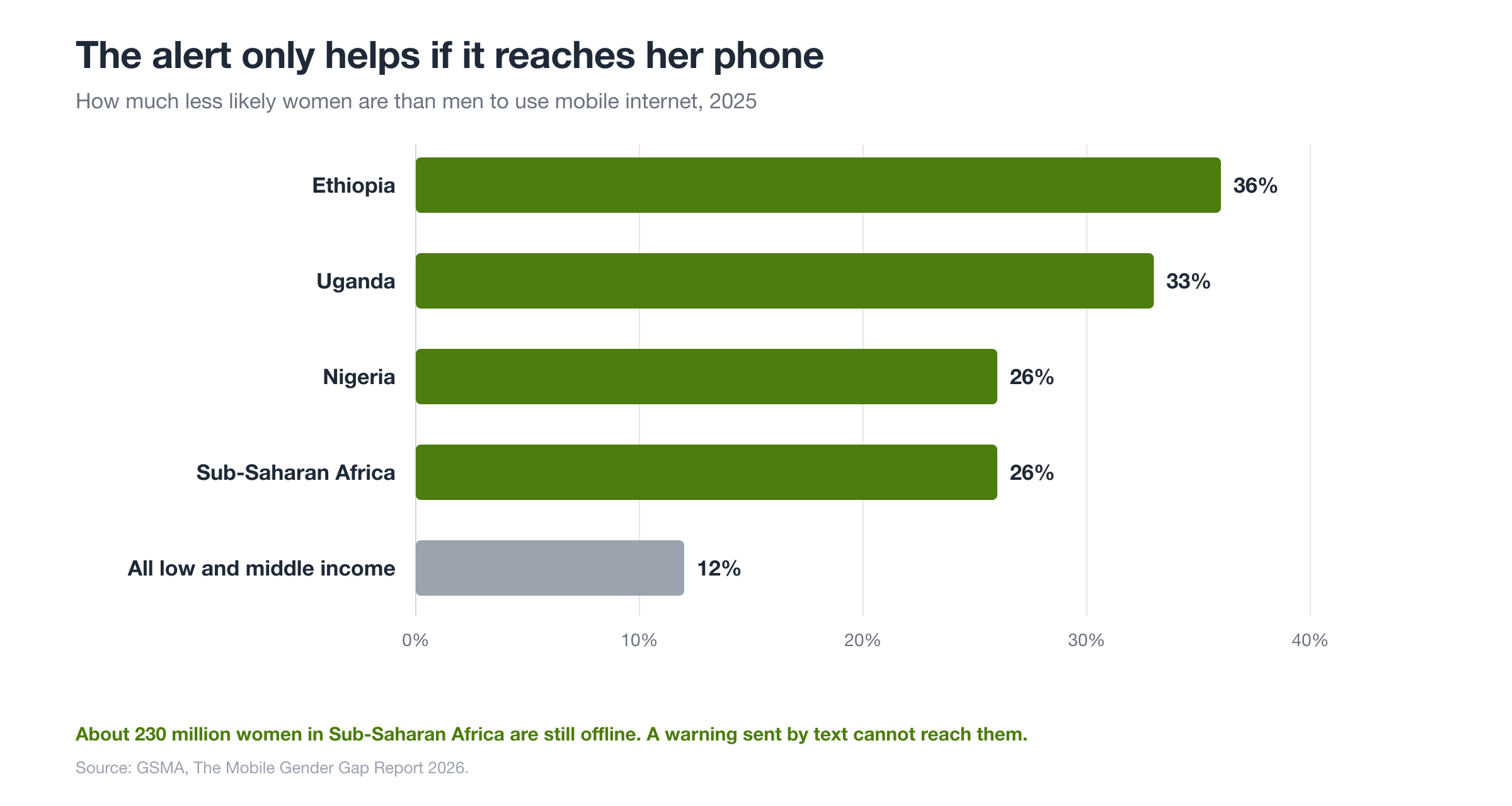
Women in Sub-Saharan Africa were 26 percent less likely than men to use mobile internet in 2025, and about 230 million of them remain offline, the GSMA found. In Uganda the gap is 33 percent. A warning system that lives in an app, needs a data bundle or assumes a smartphone will reach the cage owner and miss the trader, even though both lose money when the fish die.
The World Bank's World Development Report 2026 is optimistic about what AI can do in economies like Kenya's, precisely because most work there is hands-on and hard to automate.
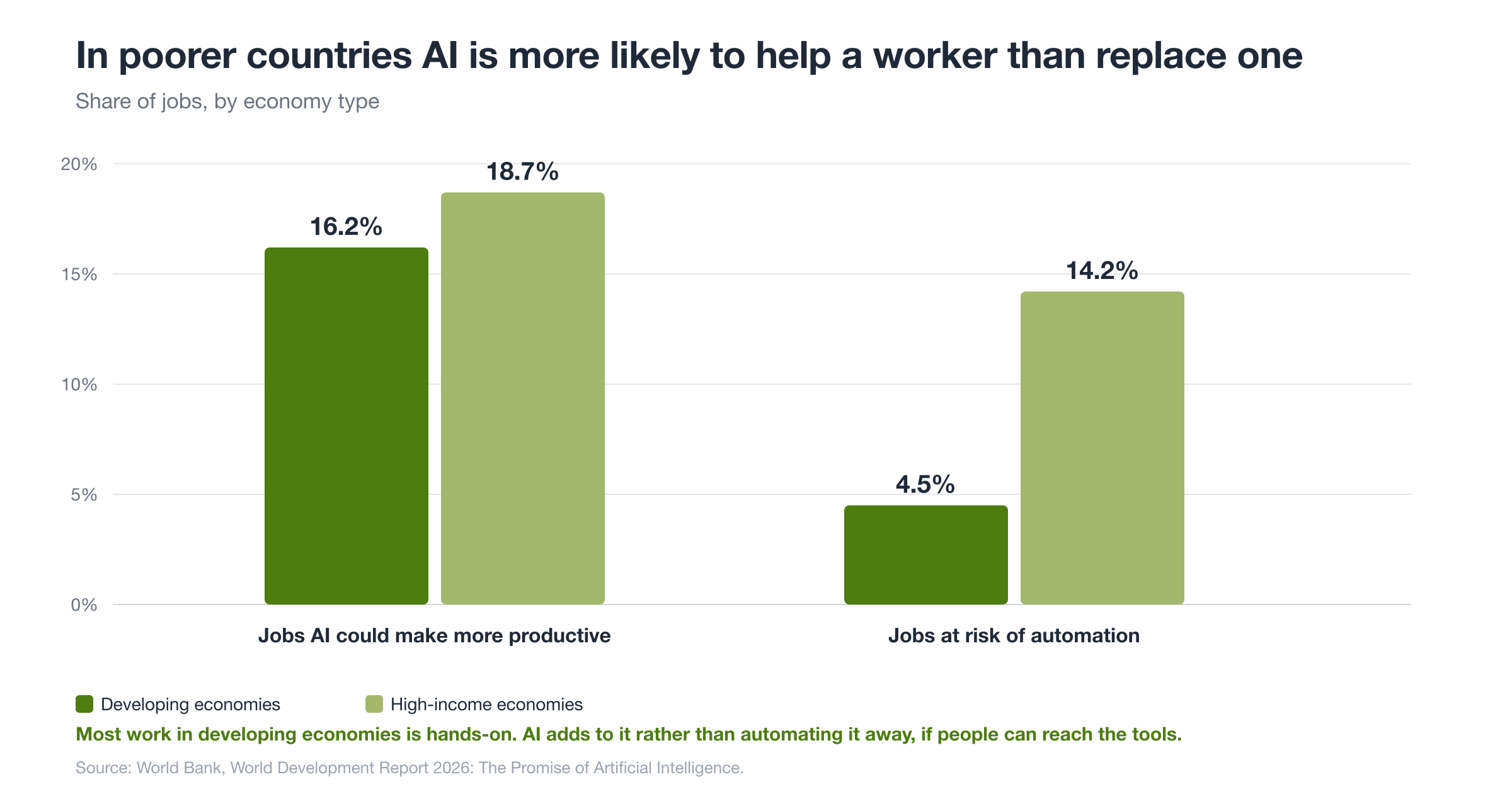
The same report is blunt about the condition attached. The gains arrive only where power, connectivity, skills, and institutions already exist. Without them, AI makes the well-connected more productive and leaves everyone else where they were. A sector can get more efficient without getting any fairer.
Who is in the data?
Every model learns from the records it is given, and fisheries records have a long-standing blind spot. They count boats, trips and kilograms landed. They rarely count the woman who smoked the fish or the one who carried it to market. WorldFish has said for years that the shortage of data broken down by sex is a main reason women stay invisible in fisheries policy.
Feed that data into a model, and the model inherits the blind spot. It will produce a sharper picture of who is fishing and no better picture of who is feeding the town.
The world has just seen how far AI can extend the eyes of a fisheries manager. Using satellite images and machine learning, Global Fishing Watch found that three quarters of the world's industrial fishing vessels do not appear in public tracking systems, with much of that hidden activity off Africa and South Asia. That is a real gain for governments trying to police their waters. But it is a view from orbit. It sees hulls, not the beach.
Who decides?
The most useful counter-example is not an AI project at all. Abalobi, a South African app built with small-scale fishers, the University of Cape Town, and the fisheries department, lets fishers log their own catches and sell traceable fish to restaurants. Its founding rule, as SciDev.Net reported, is that the fishers own their data and decide who sees it.
Compare that with the typical monitoring system, which records who fished, where and how much, and offers the fisher no way to see their own record, let alone control it. As AI makes that data more valuable, the question of who owns it stops being a technicality. It decides whether the technology is a service to fishing communities or a service about them.
It also decides which problems get solved. A model designed around a large cage operator's needs will be optimized for a large cage operator. A woman trader knows prices, buyers, seasons, and which beach to be on at what hour. If she is not in the room when the problem is chosen, the tool will not solve hers.
Four questions before the next system is switched on
Governments, donors, and start-ups planning the next Dunga Beach could ask four things before they build.
1. Can the alert reach a basic phone, in the local language, without a data bundle? If not, half the beach is not on the list.
2. Does the data count the whole chain, including processing and trading, and does it record who is doing each job?
3. Do the people being monitored own their records and choose who else can see them?
4. Was a woman trader at the table when the problem was chosen, not just when the results were presented?
None of these makes the model smarter. All of them decide who benefits when it is right.
The oxygen will fall again on Lake Victoria. Next time the message goes out, the measure of success will not only be how many cages were moved. It will be how many people were on the list. Farmers, traders, and researchers comparing notes on tools like this can do so in the Eagmark community.