You sent your soil samples to the lab. The results came back. Numbers look reasonable. You plan your fertilizer application accordingly.
But here's something most farmers never ask: which testing method did the lab actually use?
It's a question that could mean the difference between a thriving crop and wasted money — or worse, nutrient deficiency at the most critical growth stage. And it's a question that matters whether you're farming maize in Kenya, rice paddies in Southeast Asia, wheat in South America, or soybeans in North America.
The uncomfortable truth: not all soil tests measure the same thing
A soil test doesn't tell you exactly how much of a nutrient is in your soil. It estimates how much is available to your crops during the growing season. That estimate depends entirely on the chemical solution (called an extractant) the lab uses and how they measure what's extracted.
Different methods. Different numbers. Same soil.
This isn't a flaw in the science — it's by design. Each method was developed for specific soil types and conditions. The problem arises when farmers, agronomists, or extension officers interpret results from one method using guidelines built for another.
Phosphorus: The nutrient where method matters most
Phosphorus (P) testing is where confusion runs deepest. Here's why:
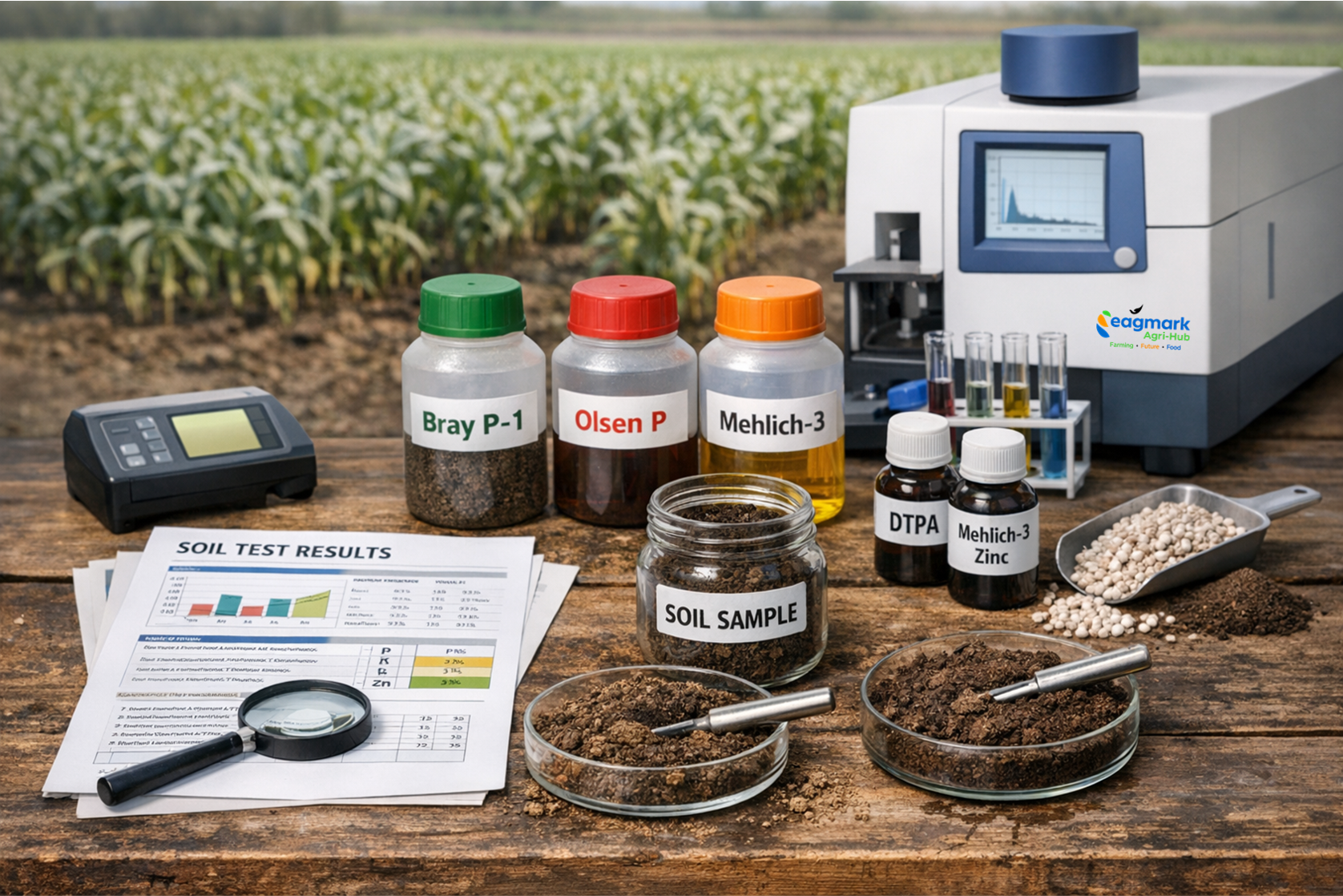
There are several widely used extractants — Bray-1, Olsen, and Mehlich-3. Each pulls a different amount of P from the soil. But the measurement technique matters just as much as the extractant:
Colorimetric analysis measures only orthophosphate P — the form most directly available to plants
ICP (Inductively Coupled Plasma) analysis measures all dissolved P forms — and consistently reads higher
Many laboratories worldwide have shifted to the Mehlich-3 extractant with ICP measurement because it's efficient. One solution, one instrument, and they can measure P, potassium, calcium, magnesium, zinc, and more in a single pass. It saves time and cost.
But here's the catch: Mehlich-3 colorimetric and Mehlich-3 ICP can give you significantly different P values from the exact same soil sample. Some labs even report ICP results converted to colorimetric equivalents using their own transformation factors — without always telling you.
If your fertilizer recommendation chart was built on colorimetric data and your lab gave you ICP numbers, you could be under-applying or over-applying phosphorus without knowing it.
One more critical note for tropical and alkaline soils: The Bray-1 method breaks down in calcareous soils (pH 7.3 and above) — common across large parts of Africa, the Middle East, and South Asia. If your lab is using Bray-1 on high-pH soils, those phosphorus results may be unreliable. The Olsen or Mehlich-3 methods are far more appropriate in those conditions.
Potassium: Wet vs. dry changes everything
Potassium (K) testing introduces another variable that catches many farmers off guard: whether the soil sample was tested dry or moist.
Research has shown that drying soil samples before testing can significantly alter potassium readings — especially in poorly drained soils. Clays that swell and shrink with moisture can trap or release potassium during the drying process, giving you a number that doesn't reflect field reality.
Moist soil testing (sometimes called the "slurry method") was developed precisely to address this. In soils with moderate to poor drainage — common in floodplains, valley bottoms, and irrigated fields across the tropics — the moist test is considerably more reliable.
The two common K extractants (ammonium acetate and Mehlich-3) give comparable results. But there is no simple conversion factor between dry and moist test results. They require separate interpretation guidelines.
If your lab doesn't specify whether the test was run on dried or field-moist samples, you're missing half the story.
Zinc: Small nutrient, big testing differences
Zinc deficiency is one of the most widespread micronutrient problems globally — affecting crops from rice in Asia to maize in sub-Saharan Africa. Two methods dominate zinc soil testing:
DTPA — the traditional, targeted zinc extractant
Mehlich-3 — which extracts noticeably more zinc from the same soil
Both are valid, but their results are not interchangeable. A soil reading of 1.5 ppm Zn means something very different depending on which method produced it. Using Mehlich-3 zinc values with DTPA-based recommendation thresholds could lead you to skip a zinc application your crop desperately needs.
What you should do right now
The next time you receive soil test results — whether from a government extension lab, a private laboratory, or a cooperative testing service — ask these five questions:
Which extractant was used for phosphorus? (Bray-1, Olsen, or Mehlich-3?)
How was phosphorus measured? (Colorimetric or ICP?)
Was potassium tested on dried or moist soil?
Which extractant was used for potassium? (Ammonium acetate or Mehlich-3?)
Which method was used for zinc? (DTPA or Mehlich-3?)
If the lab report doesn't clearly state the methods, call them and ask. A reputable lab will answer without hesitation.
Why this matters for every farmer on Eagmark
Whether you're managing a 2-hectare vegetable plot or a 2,000-hectare commercial operation, soil testing is only as useful as your ability to interpret it correctly. The numbers on that report are not universal truths — they are method-specific estimates. Match them to the wrong interpretation guide, and your entire nutrient management plan starts on a false foundation.
Good soil testing isn't just about sending samples to a lab. It's about knowing what question the lab answered — and making sure it's the right question for your soil, your crops, and your climate.
Your soil is talking. Make sure you're reading the right translation.