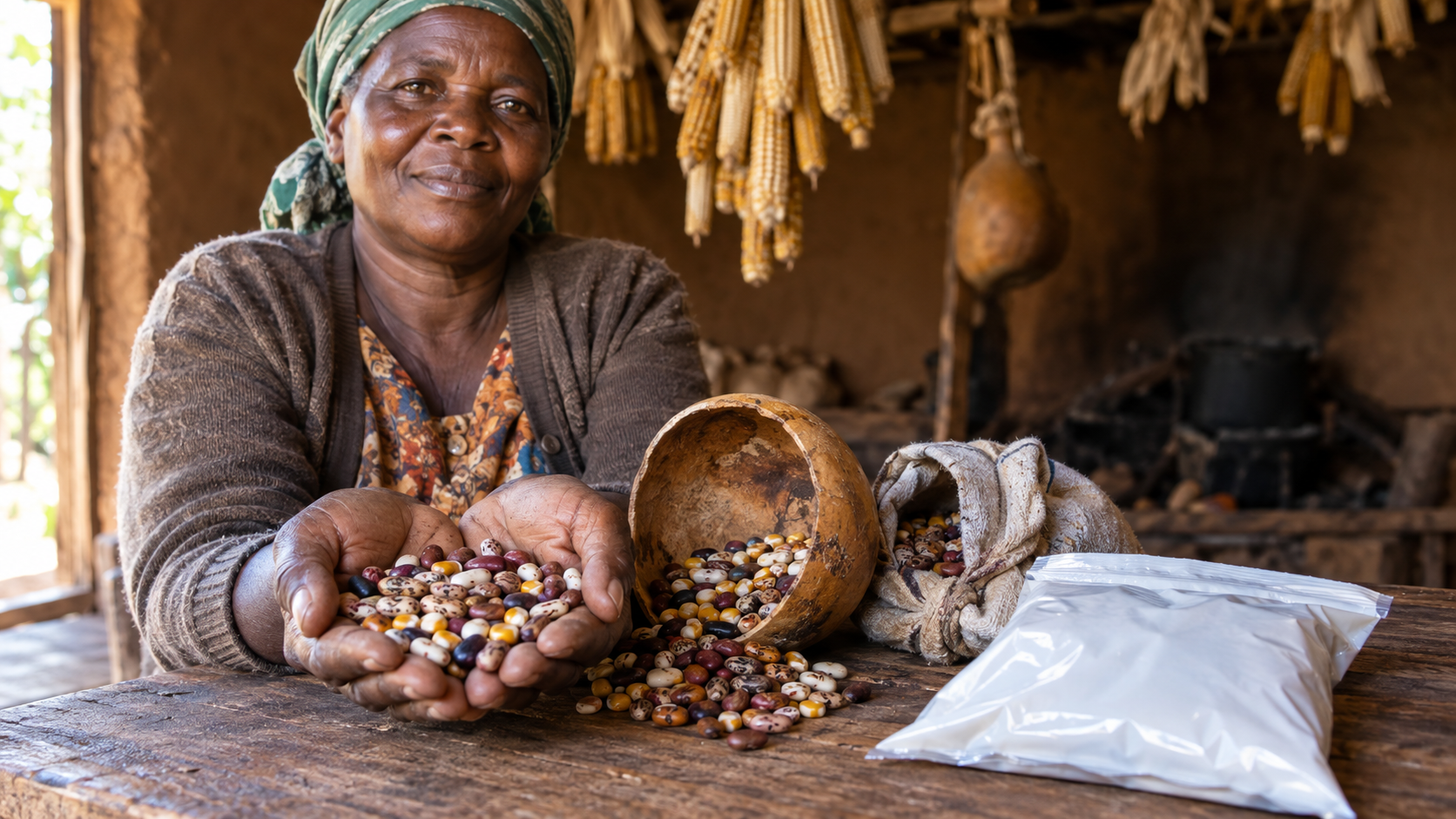
For most of farming history, the harvest paid for the next season twice. Once in food or cash, and once in the handful of grain set aside in a gourd above the fire for planting. That second payment is quietly disappearing. A growing share of what African farmers plant is seed that either cannot be kept, should not be kept, or legally may not be kept. Every one of those changes moves money and control away from the farm.
A market run by four
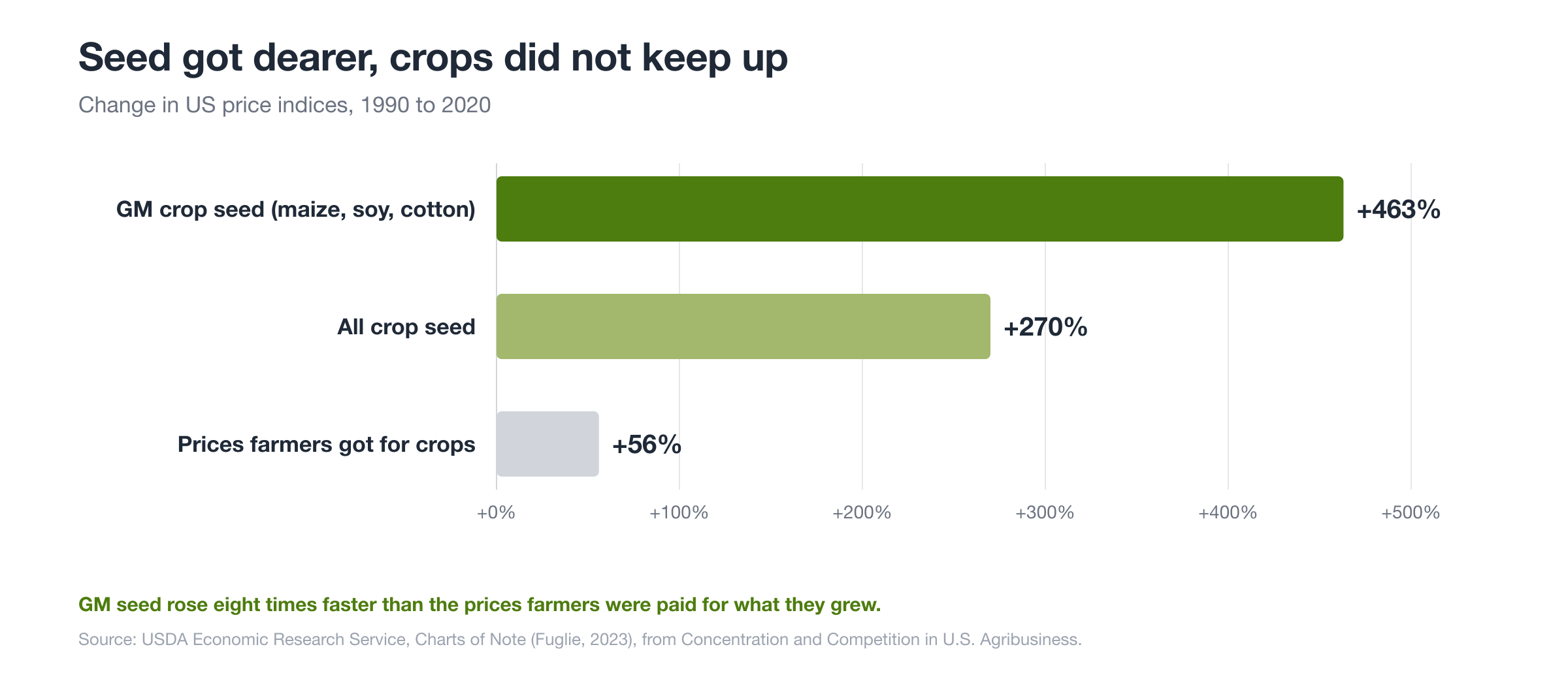
In June, three plant scientists at the University of Wisconsin set out what this has meant in the United States. Two companies sell more than 70 percent of American maize and soybean seed. Seed for genetically engineered crops rose in price by 463 percent between 1990 and 2020, according to the US Department of Agriculture, while the prices farmers received for their crops rose by 56 percent. Even the US Justice Department, in a May 2026 filing in a dispute between Corteva and the gene-editing startup Inari, described the seed industry as highly concentrated and hard for newcomers to enter.
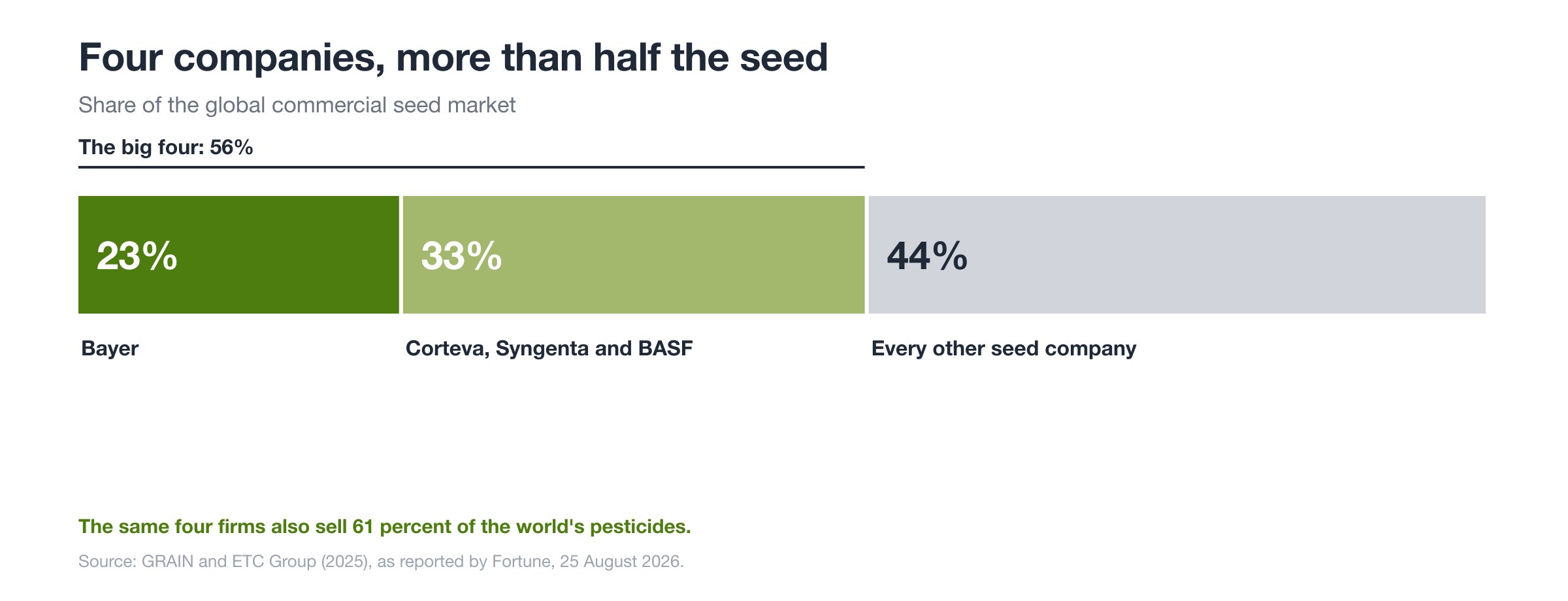
It would be easy to treat this as an American problem. It is not. The same four firms, Bayer, Corteva, Syngenta and BASF, now account for about 56 percent of the world's commercial seed, and Bayer alone for close to a quarter. Their genetics and brands sit inside the maize, vegetable and cotton seed sold across East and Southern Africa. In South Africa, a government market review found that four companies owned 68 percent of registered maize varieties, and noted that actual market shares could not be measured because the companies keep them confidential. That secrecy is the same complaint the Wisconsin authors make about American seed.
Africa still keeps its own seed, for now
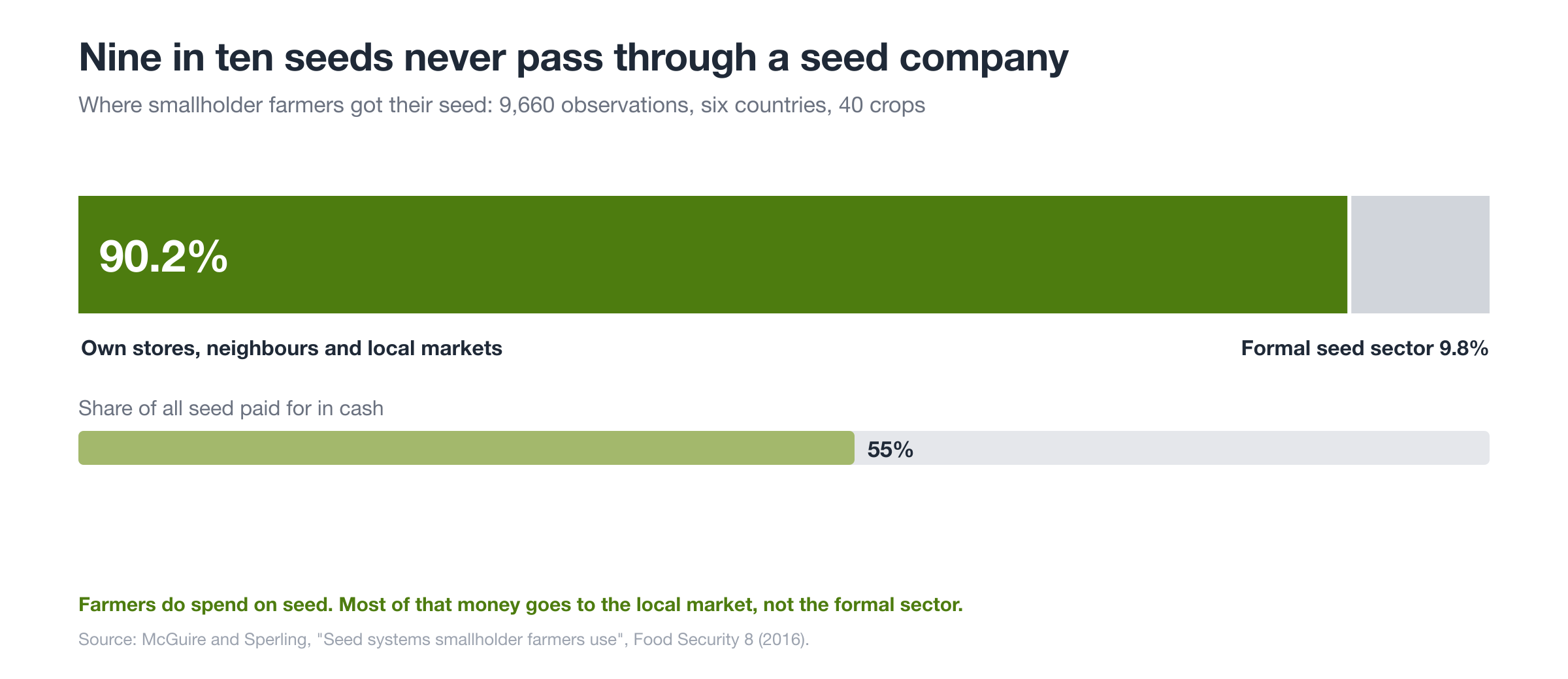
The picture on African farms looks very different, and this is the part that matters. When researchers pooled 9,660 seed purchases and plantings across six countries and 40 crops, they found that smallholders got just over 90 percent of their seed outside the formal system: from their own stores, from neighbors, and above all from the local market. More than half of all seed was paid for in cash, which tells you farmers are not avoiding spending on seed. They are spending it in places the formal industry does not reach.
That farmer-held system is the insurance policy the Wisconsin authors describe losing in America. Hundreds of local sorghum, millet, bean and cowpea types, each a little different, mean that no single disease or dry spell can wipe out a whole district. The question for Africa is whether that system is replaced, or improved alongside.
Three ways a seed stops being yours
1. Hybrids that do not repeat themselves. A hybrid is the first-generation child of two carefully kept parent lines. It grows vigorously and evenly. Its own seed, however, scatters back towards the traits of its grandparents. Replanting is possible but costly. In Kenyan trials, farmers who replanted grain from a hybrid harvest lost about 16 percent of yield in the first replanting and up to a third or more by the third, depending on the type of hybrid. A KALRO official said in 2019 that close to a third of Kenyan farmers had been doing exactly that for years, because fresh seed cost more than they had at planting time.
No law stops a farmer replanting a hybrid. Biology does the work instead, and the parent lines that would let anyone else produce the same seed stay locked inside the breeder's company.
2. Seedless crops. The seedless watermelon in a Nairobi supermarket is a clever piece of breeding. It comes from crossing a plant with doubled chromosomes with an ordinary one, which produces a sterile fruit. Every seed has to be made again from those two parents, every season, by whoever owns them. A grower must buy new seed each time, often at several times the price of ordinary watermelon seed, and must also plant a seeded pollinator variety alongside. Seedless crops are not all like this. Bananas, cassava, sweet potato and Irish potato are grown from cuttings, suckers and tubers, and farmers have multiplied them for centuries. Clean tissue-culture banana plantlets cost money at the start, but once a healthy mat is established, the farmer can raise suckers from it. The lock comes from who controls the parent material, not from the absence of seeds.
3. Patents and plant variety rights. This is the legal layer, and it is spreading. Kenya and Tanzania have joined the 1991 version of the UPOV convention, which narrows what a farmer may do with seed of a protected variety. The Arusha Protocol, modelled on the same convention, came into force for its member states in November 2024. It grants breeders 20 to 25 years of protection and allows farm-saved seed only within limits, and in some cases against a payment to the rights holder. Supporters argue that without protection, breeders will not invest in varieties for African conditions. Critics, including the Alliance for Food Sovereignty in Africa, say it treats a centuries-old farm practice as an exception to be tolerated rather than a right.
Genetically modified traits add another tier. Nigeria approved TELA maize, which combines drought tolerance with insect protection, in 2021. Kenya lifted its GM ban in 2022, only for the Court of Appeal to freeze the decision in March 2025, barring the government from allowing GM crop and food imports or taking any further step to act on the lifting of the ban while the Kenyan Peasants League appeal is heard. The judges noted that GM crops are extremely difficult to withdraw once farmers adopt them, and that trying to do so later could expose the country to "claims by patent holders and importers". The full appeal was argued in December 2025 and judgment was expected on 24 April 2026. It has been delayed, so the freeze still stands. Whatever one thinks of GM crops, a patented trait is a patented trait. It comes with licensing terms, and those terms decide whether a local seed company can breed with it.
Courts are starting to draw lines
Kenya has gone furthest in testing where those lines sit. Under the Seed and Plant Varieties Act, a farmer who sold or swapped uncertified seed faced a fine of up to KSh 1 million and two years in prison. In 2022, fifteen smallholders challenged that. On 27 November 2025, in Wathome and 14 others v KEPHIS, the High Court in Machakos struck down the sections that criminalised selling and exchanging uncertified seed and that let inspectors seize seed on an undefined "reasonable belief". It found that the KSh 75,000 fee to register as a seed merchant, plus KSh 10,000 a year to renew, shut small-scale farmers out in favour of large commercial players.
The ruling went further than the headlines suggested. Justice Rhoda Rutto also struck down section 20(1) and 20(1E), the clauses that gave plant breeders control over a protected variety and allowed farmers to replant their harvest only "within reasonable limits". Her reasoning goes to the heart of this article: once a farmer has bought a protected variety and grown it, "the harvest constitutes the farmer's property", and limiting its saving, sale, exchange or sharing infringes the right to own property. That puts Kenyan law at odds with the UPOV 1991 rules the country has signed up to, a tension the appeal will now have to settle. The Attorney-General and the plant health regulator KEPHIS have appealed, but in March 2026 the Court of Appeal declined to suspend the judgment. Until the full appeal is decided, saving and sharing seed is lawful across Kenya.
The American case points in a surprisingly similar direction. When a company patents a seed in the US, it must deposit a sample in a public repository, so that others can learn from it. Corteva argued that Inari had no right to obtain and sequence those deposited seeds. The Justice Department pushed back, saying a company that relies on a public deposit to win a patent cannot then use the patent to stop others studying it. Both courts, in very different settings, are asking the same question: how much of a seed's knowledge can be closed off, and for how long?
What it costs, and who pays
Seed is not a small line in an African farm budget. Kenya's government has spent several seasons subsidizing certified maize seed, and in August 2026 the Agriculture Cabinet Secretary announced a further cut to KSh 150 a kilogram from KSh 300. That is the same pattern the Wisconsin authors found in America, where every 1 percent rise in farm support was matched by a half-percent rise in seed prices. Public money that is meant for farmers can end up supporting seed company margins if there is little competition to keep prices honest.
None of this means hybrids are a trap. Good hybrids raise maize yields well beyond what most saved seed can deliver, and many farmers buy them gladly. The point is choice. A farmer who can buy a hybrid one year, plant a good open-pollinated variety the next, and swap bean seed with a neighbor without fear of arrest is in a far stronger position than one with a single supplier.
Keeping your options open
1. Know what you are planting. A hybrid, an open-pollinated variety and a farmer variety behave differently when you save seed. Check the bag, and ask the agro-dealer.
2. Count the replanting loss honestly. If saved hybrid grain costs you a sixth of your yield, compare that loss in shillings against the price of fresh seed before deciding.
3. Keep an open-pollinated or local line going. Even a small plot of a good open-pollinated maize, sorghum or bean variety gives you seed you can legally and biologically keep.
4. Use community seed banks. Kenya's court ruling has made them safer to run. They hold the diversity no single company will.
5. Share what you pay. Seed prices only stay honest when farmers can see them. Report what you paid for seed and other inputs on Eagmark's Input Price Check, and see the median paid in your area before you buy.
The harvest used to pay for the next one. Whether it still can is now being decided in breeding labs, parliaments and courtrooms. Farmers deserve a seat in all three.