Walk into almost any food company's sustainability report this year and you'll find the word "regenerative." Cover crops, reduced tillage, rotational grazing, healthier soil. The language is everywhere.
The numbers behind that language tell a different story.
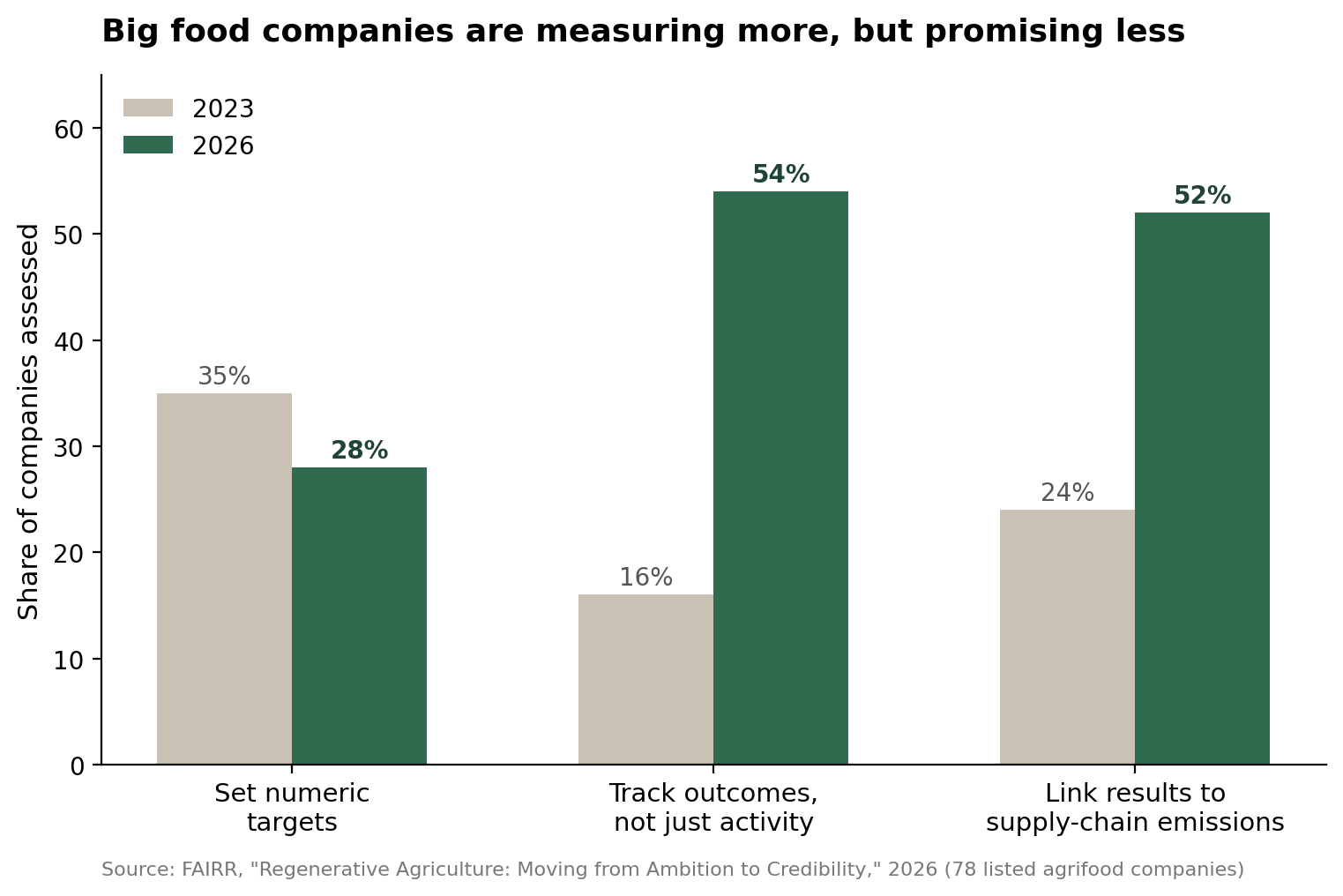
In 2023, 35% of the world's largest publicly listed agrifood companies had set a numeric target for regenerative farming. By 2026, that figure had dropped to 28%. Fewer companies today are willing to put a number next to their promise than three years ago, according to a 2026 assessment by the investor network FAIRR, which reviewed 78 companies with combined revenues of $3.3 trillion.
That's not a small shift. It's a signal.
Something odd is happening at the same time
Here's the part that makes this interesting. While fewer companies are setting hard targets, more of them are actually measuring what's happening on the ground.
The share of companies tracking regenerative outcomes, not just counting how many acres are enrolled in a program, jumped from 16% to 54% over the same three years. Companies linking their farm-level work to supply-chain emissions goals nearly doubled too, from 24% to 52%.
So companies are watching their fields more closely than ever. They're just less willing to promise what they'll find.
Why would a company measure more and promise less? Ask yourself what happens when you finally start checking your work carefully. You find out how hard the work really is.
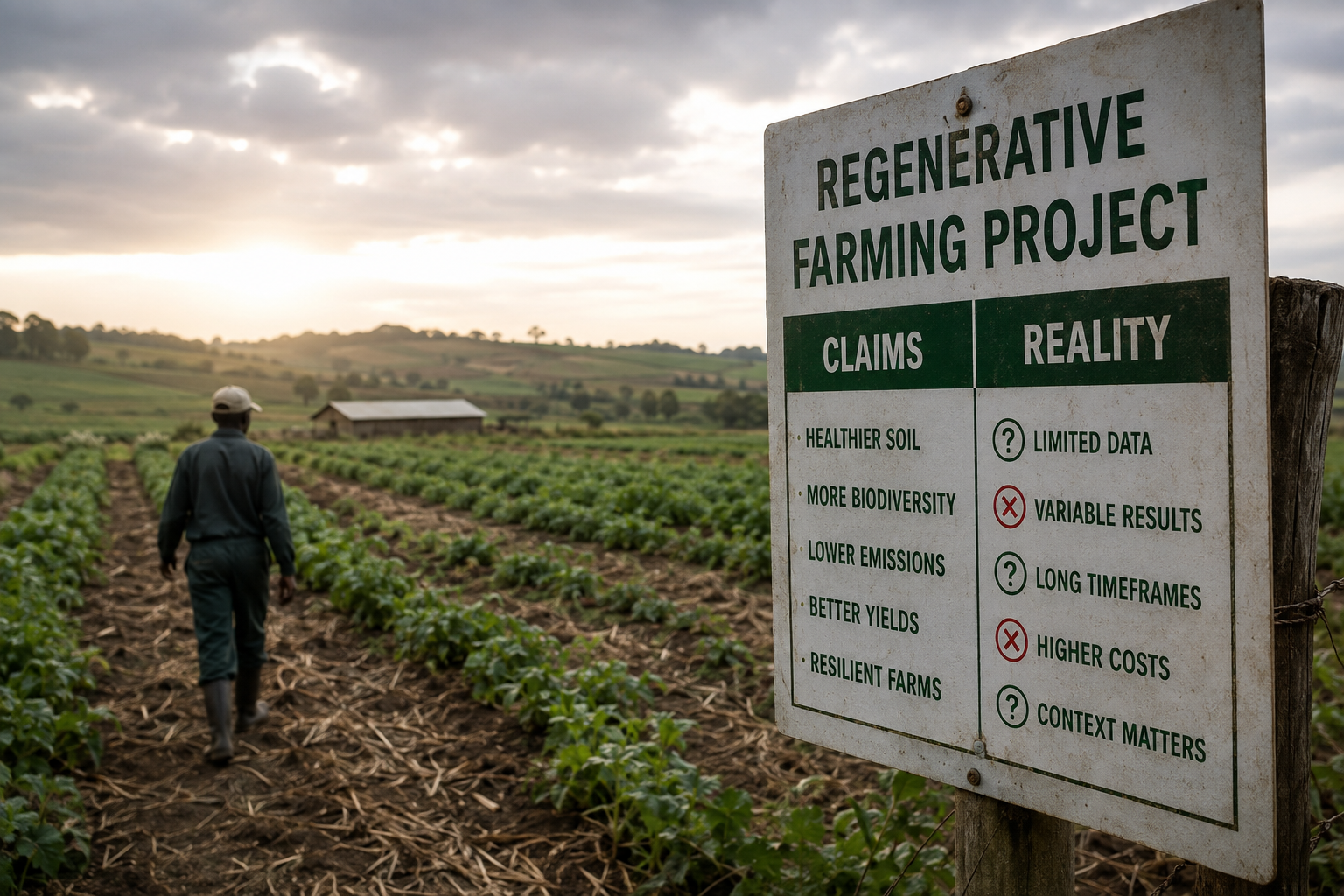
Soil doesn't change on a spreadsheet timeline. A farm in western Kenya and a farm in Iowa can apply the exact same practice and get entirely different results, because the soil, the rainfall, the crop, and the season are never the same twice. Companies that started measuring seriously ran into that reality, and many pulled their public targets back rather than risk a number they couldn't defend.
Only 4% of companies in the FAIRR review have set targets based on actual outcomes, things like water saved, carbon stored, or yield stabilized. Everyone else is still measuring activity: how many farmers joined, how many hectares are enrolled, how many training sessions were held.
Activity is not the same as impact. Planting a cover crop is an action. Whether that cover crop actually held moisture in the soil during a dry season is an outcome. Only one of those tells you if the money and effort worked.
Why one field can succeed while the next one fails
Regenerative practices don't behave the same way twice.
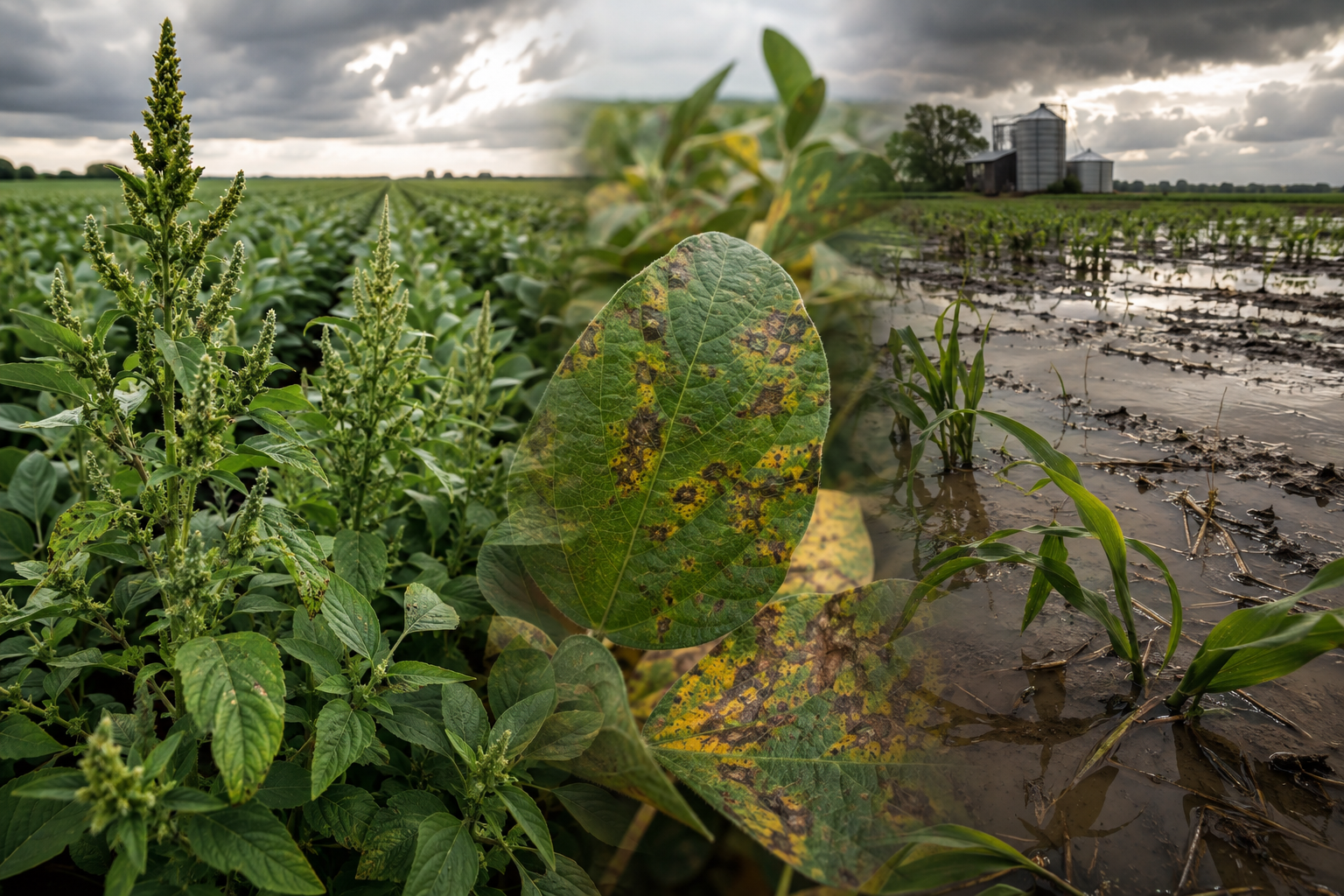
Cover cropping is a good example. In a place with steady rainfall, it can suppress weeds, stop erosion, and build organic matter in the soil over a few seasons. In a drier region, that same cover crop can pull moisture away from the main crop and hurt the harvest it was meant to protect.
Reduced tillage works well in some soil types and creates compaction problems in others. Integrated livestock grazing can restore degraded pasture in one region and overgraze fragile grassland in another if the timing is off.
This is why a company can't simply copy a regenerative playbook from one country to the next and expect the same result. What works on a research farm in the Netherlands may need a completely different approach on a smallholder plot in Nyeri County or a cotton farm in Gujarat.
If you're a buyer, an investor, or a company setting these targets, this raises an uncomfortable question. How do you know a claim is real if the practice behind it doesn't behave consistently?
What it actually takes to prove a result
Real proof starts before a single seed goes into the ground.
A baseline, set first. You can't show change if you never measured the starting point. A credible program records soil carbon, water use, or yield data before the intervention begins, not after someone asks for a report.
A method chosen up front, and used consistently. Water outcomes are usually measured against a recognized approach such as the World Resources Institute's Volumetric Water Benefit Accounting methodology. On-farm sustainability performance more broadly is often assessed using the Sustainable Agriculture Initiative Platform's Farm Sustainability Assessment. Whatever the method, switching frameworks halfway through a program makes the final numbers meaningless.
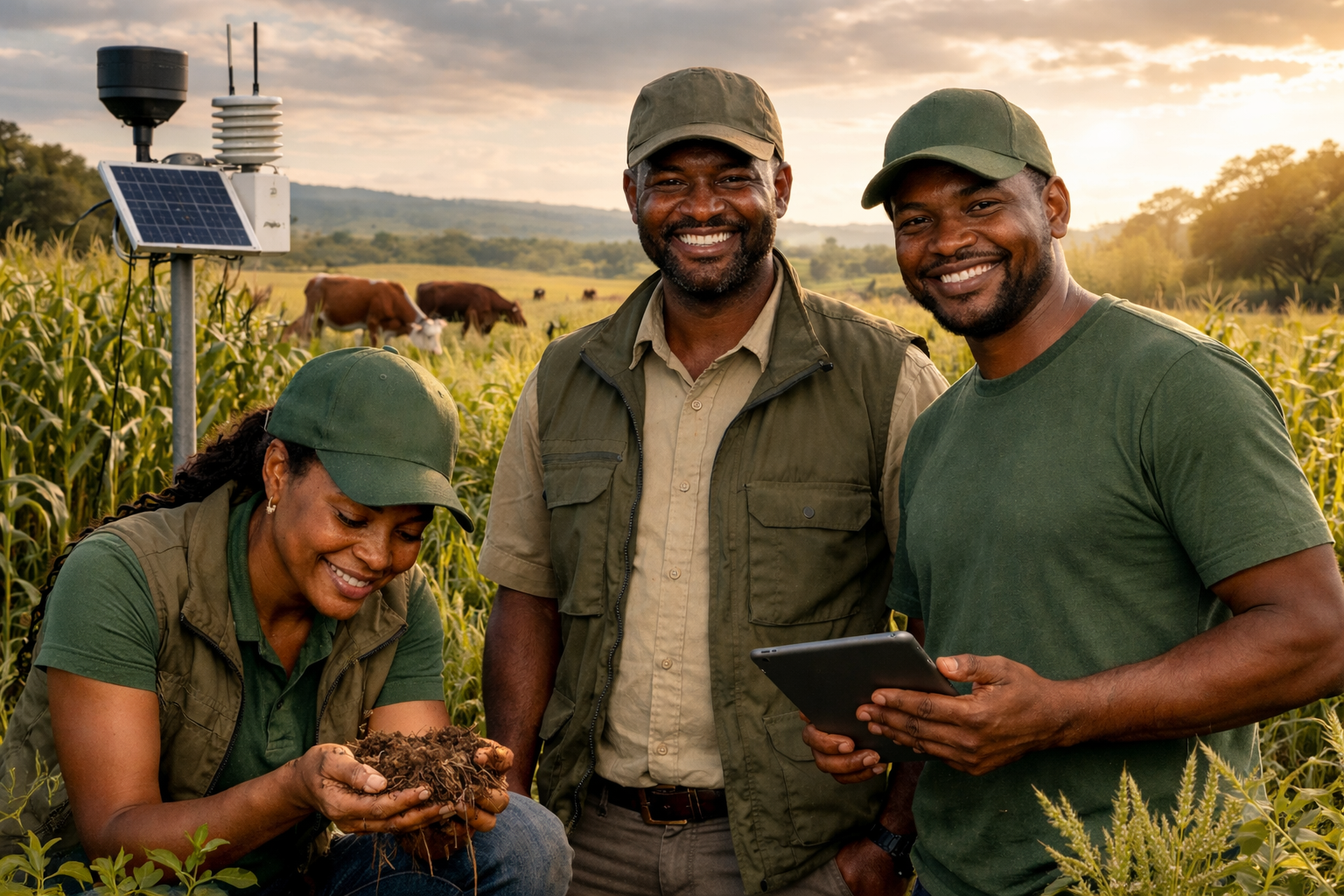
Farmers who understand why they're collecting data. The people recording field data every day are farmers, not analysts in a head office. If a farmer doesn't understand why a measurement matters, or if the process doesn't match how they actually work their land, the data comes back patchy and unreliable. Training and ongoing agronomic support aren't a nice extra. They're part of the measurement system itself.
Technology that supports judgment, not replaces it. Satellite imagery, soil sensors, and remote monitoring can track changes across thousands of farms at once and flag anomalies no single agronomist could catch by hand. But a sensor reading without local context is just a number. The strongest programs pair digital tools with people who understand the specific soil, crop, and community behind each data point.
Independent verification. A claim that can't survive an outside audit isn't a claim, it's a hope.
The gap that gets overlooked
There's one more pattern in the FAIRR data worth sitting with. Regenerative frameworks are applied to crop farming by 70% of companies. For pork and poultry supply chains, that number drops to 10%.
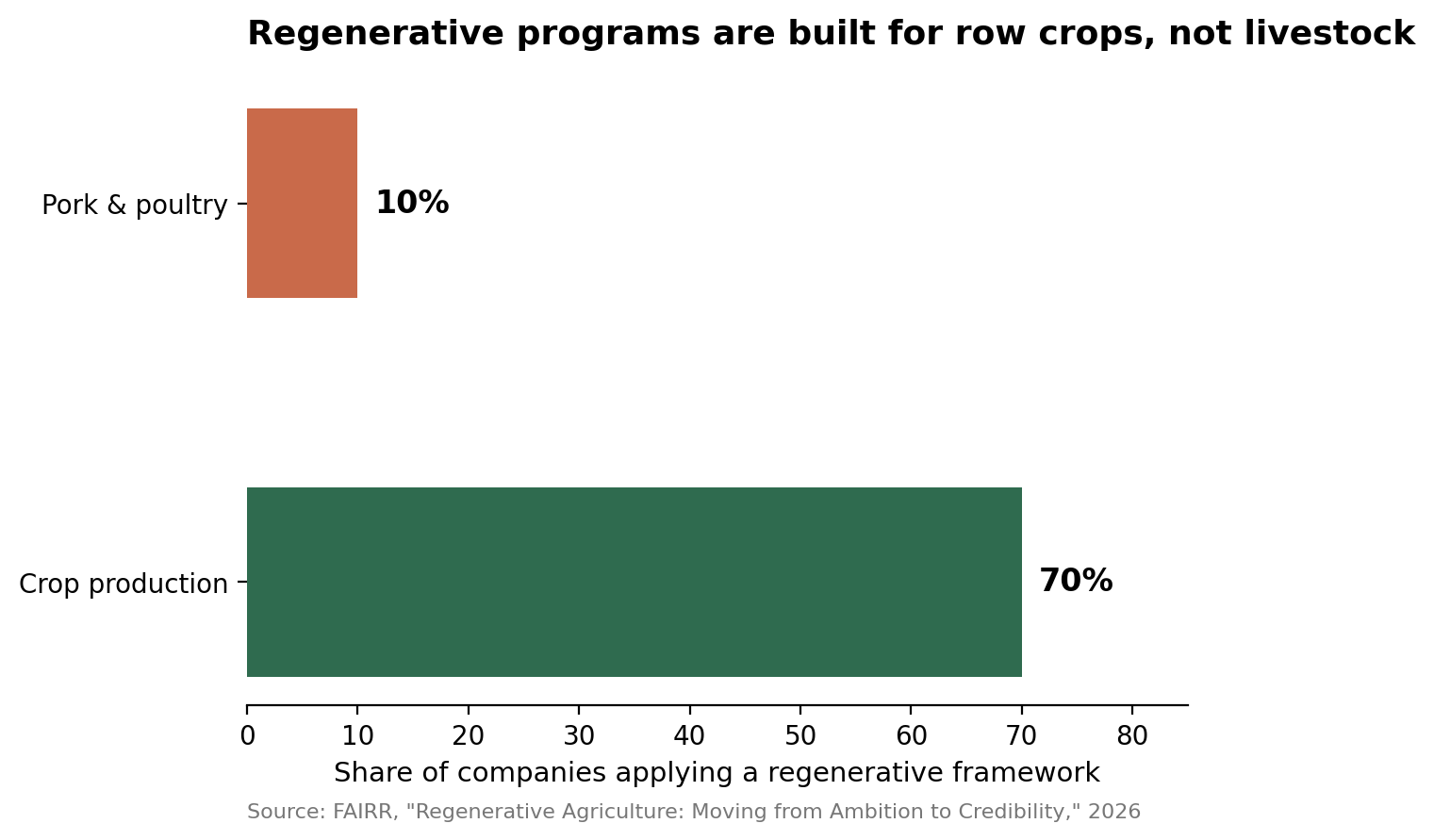
Livestock supply chains carry real climate and resilience risk, yet they remain almost untouched by the same rigor applied to row crops. If you're evaluating a company's regenerative claims, ask what portion of their actual supply chain the numbers cover. A strong result in wheat means little if the company's pork division was never measured at all.
What 2030 will actually reward
Four years is not a long runway for agriculture. Soil health builds over seasons, not quarters.
The companies that will be able to stand behind their 2030 claims are the ones building measurement into their programs now, not the ones writing the most ambitious pledge today and hoping the data catches up later.
That means setting a baseline before asking farmers to change anything. Choosing one method and sticking with it. Investing in the people collecting the data as much as the sensors reading it. And being honest, publicly, about what hasn't been measured yet.
The next time you read a regenerative agriculture claim, don't ask what the company did. Ask what changed, compared to what, and who checked.
That question is the difference between a practice and proof.