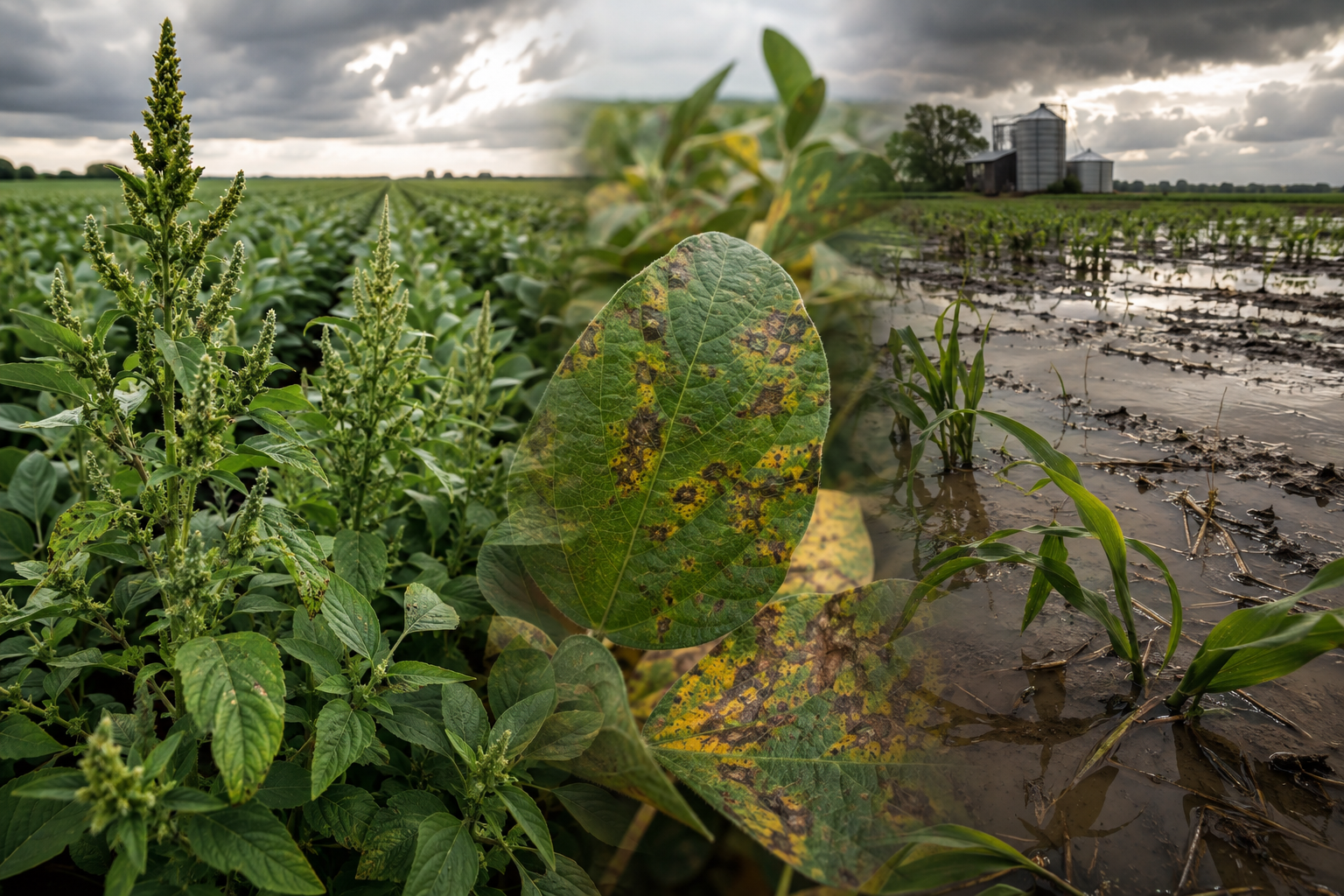
Ask a farmer in Iowa, Punjab, or the Rift Valley what keeps them up at night, and you will hear three answers on repeat. Weeds that no longer die when sprayed. Disease that shows up too late to stop. Fields so waterlogged that machinery cannot even reach the crop.
These are not new problems. But in 2026, they have become the defining ones. And the numbers behind them explain why.
The weeds are winning
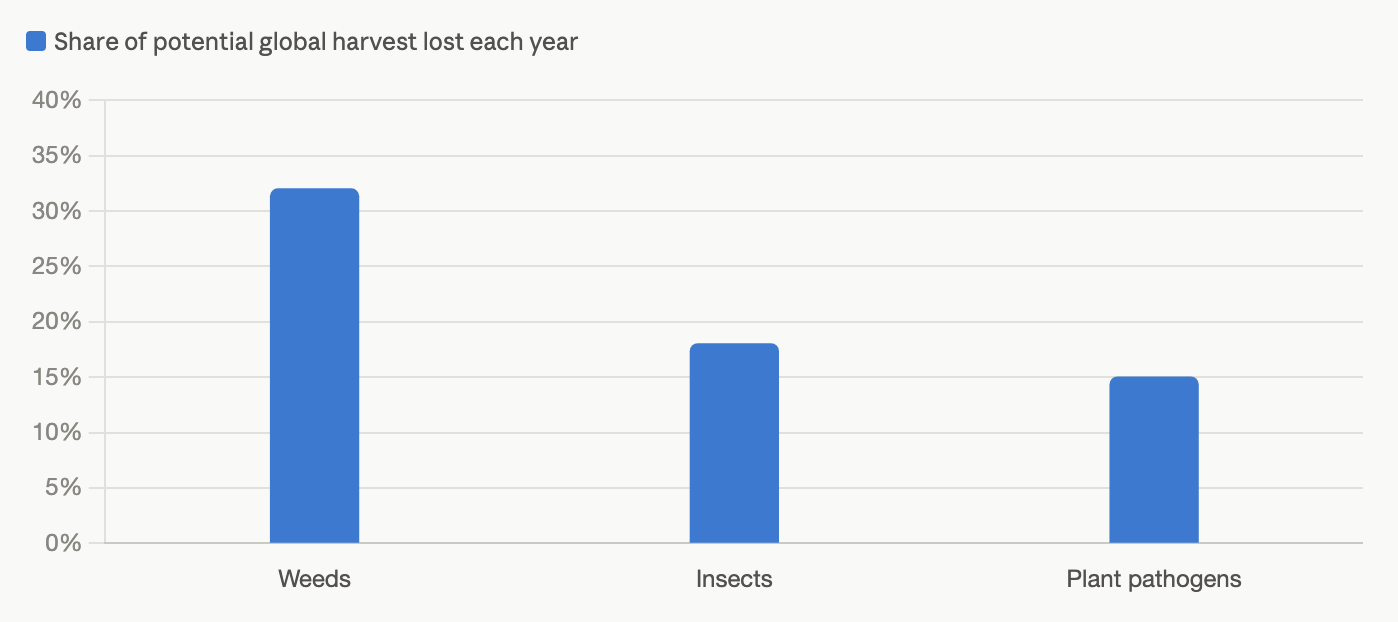
Weeds are the single biggest drain on global food production. Left unchecked, they wipe out roughly 32 percent of potential crop yield worldwide, more than insects and plant disease combined, according to research compiled in a 2024 organic weed control study published on arXiv. The Food and Agriculture Organization puts the figure at close to 30 percent as well.
The bigger problem is that the tools farmers have relied on for decades are losing their edge. Weeds evolve. Spray the same herbicide across millions of acres for enough seasons, and resistant strains take over the field. Palmer amaranth and waterhemp, two of the most stubborn offenders, have spread across the US Midwest and are turning up in new regions every year.
You can see the financial pressure building. The global herbicide-resistant weed solutions market was valued at close to 12 billion dollars in 2025 and is projected to almost double by 2035, according to market research firm GMI. That is money farmers are spending just to stand still against a problem that keeps adapting faster than the products meant to solve it.
Equipment makers have noticed. Several major manufacturers now sell machinery built to spot and destroy individual weeds using cameras and lasers instead of blanket spraying. It costs more upfront. But when resistant weeds can strip a third of your harvest, that cost starts to look like common sense rather than a luxury.
By the time you see the disease, it is often too late
Crop disease rarely announces itself early. Blight, rust, and root rot tend to spread quietly under the canopy before visible symptoms appear, and by then the intervention window has often closed.
This is where the conversation around artificial intelligence in agriculture gets real. Cameras mounted on drones or tractors can flag stress in a crop's leaf color or canopy shape days before a human scout would notice anything wrong. Used well, that early warning can be the difference between a targeted fungicide application and a lost field.
Used badly, it is just another app that promises more than it delivers. Anyone building or buying agricultural technology this year has to ask a blunt question: does this tool solve a problem farmers actually have, or does it exist because AI is easy to build with right now? Plenty of software looks impressive in a demo and falls apart in a muddy field with patchy internet.
Fields that will not drain
The third pain point gets less attention than weeds and disease, but it may be the most physically limiting. Poor drainage and waterlogging keep farmers off their own land.
Roughly 16 percent of the world's farmland is regularly affected by flooding or waterlogging, and that alone accounts for about a fifth of annual production losses, worth an estimated 74 billion dollars a year, according to a review published in ScienceDirect. A separate global meta-analysis of more than a hundred field studies found that waterlogged crops lose close to 33 percent of their yield on average compared with well-drained fields, with cotton and chickpea among the hardest hit.
Climate patterns are making this worse, not better. Heavier, more concentrated rainfall is becoming the norm across the US Midwest, South Asia, and parts of East Africa. Soil that used to handle a wet week now floods for two. For smallholder farmers in Kenya or Tanzania without access to tiling or engineered drainage, a few days of standing water can mean the difference between a harvest and a failed season.
What actually helps
None of these three problems has a single fix. That is worth saying plainly, because a lot of agricultural technology gets marketed as if it does.
Precision spraying reduces herbicide waste but does not stop resistance from developing. Early disease detection buys time but does not replace good agronomy. Better drainage infrastructure helps, but it is expensive and slow to build, especially where farmers lack the capital or land tenure security to invest in it.
What moves the needle is layering these tools with practices that already work. Crop rotation and cover cropping slow herbicide resistance. Diversified rotations reduce disease pressure by breaking pathogen cycles. Simple interventions like raised beds and contour farming can cut waterlogging losses significantly, even without major capital investment.
The agricultural technology that earns farmers' trust in the years ahead will be the kind built alongside them, tested on real fields, under real weather, against real budgets. Not the kind built to impress an investor deck.
If you farm anywhere in the world right now, chances are at least one of these three problems already has its hand on your yield. The good news is that you are not dealing with a mystery. The data is public, the causes are understood, and a growing number of tools, from targeted weed robots to early-warning sensors to better field drainage design, are being tested against exactly these conditions. The challenge left is matching the right tool to your actual field, not the one with the flashiest pitch.