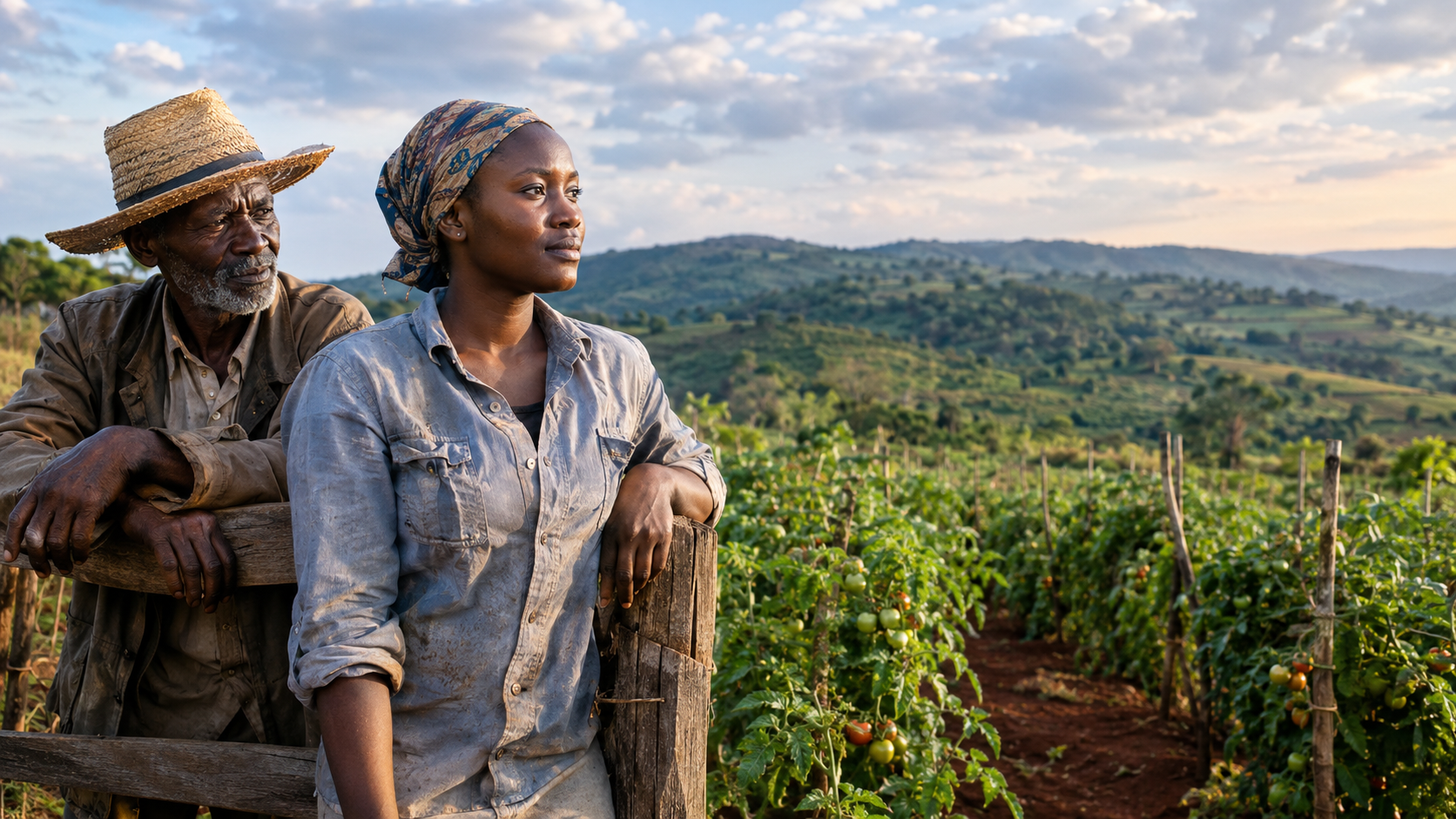
Drive north out of Nanyuki on the road that curls around Mount Kenya and the land opens up into rows of white greenhouses and irrigated fields. This is Timau, a town of around 10,000 people that grows roses, green beans and peas for supermarkets thousands of kilometres away. For many families here, the farms have meant school fees, a roof and a steady wage.
They may also have meant something else. In a detailed report from Timau, The Guardian's Carlos Mureithi spoke to former farm workers who believe the chemicals they handled for years have damaged their health for good.
One of them is Reuben Muriki. He sprayed flowers for a living until his body began to fail him. Today, at 30, he cannot walk without help and struggles to hold a conversation. His mother, who once picked roses in the greenhouses herself, now cares for him around the clock and lives with her own skin and breathing problems. A woman who spent 11 years harvesting peas and beans without gloves told the paper that her hand went numb one morning on the way to work and never fully recovered. A former sprayer from a village outside Timau now shakes so badly he cannot lift a cup.
None of these stories proves what caused each illness. But together they explain why a quiet farming town has become the centre of one of Kenya's most closely watched legal fights.
Eighty-seven people and a court petition
In 2022, the African Centre for Corrective and Preventive Action and lawyer Kelvin Kubai, who grew up in Timau, filed a petition against the Kenyan government and five pesticide makers: Monsanto, its owner Bayer, Syngenta, BASF and Nairobi-based Twiga Chemical Industries. The case challenges the sale of what the United Nations calls highly hazardous pesticides, products that the FAO and WHO consider especially dangerous to people or the environment.
The court has since allowed the petitioners to invite affected people to join, which could turn it into a class action. According to The Guardian, 87 people have come forward, Muriki among them, and a decision on whether they can join is expected early next year.
Scientists working for the petitioners say they tested all 87 for two weedkillers, paraquat and glyphosate, and found levels above reference limits in every case. These results come from one side of a live court case and have not been independently checked. Bayer and Syngenta told The Guardian their products are safe when used as the label directs. Kenya's Pest Control Products Board said it would not discuss a case that is still before the courts.
What is not in dispute is the reputation of the chemicals involved. Paraquat has been banned in the European Union since 2007, and studies have linked long-term exposure to Parkinson's disease. Glyphosate was classed as "probably carcinogenic" by the WHO's cancer agency in 2015, although the EU renewed its approval in 2023, and regulators still disagree about the risk.
Kenya sprays far more than it used to
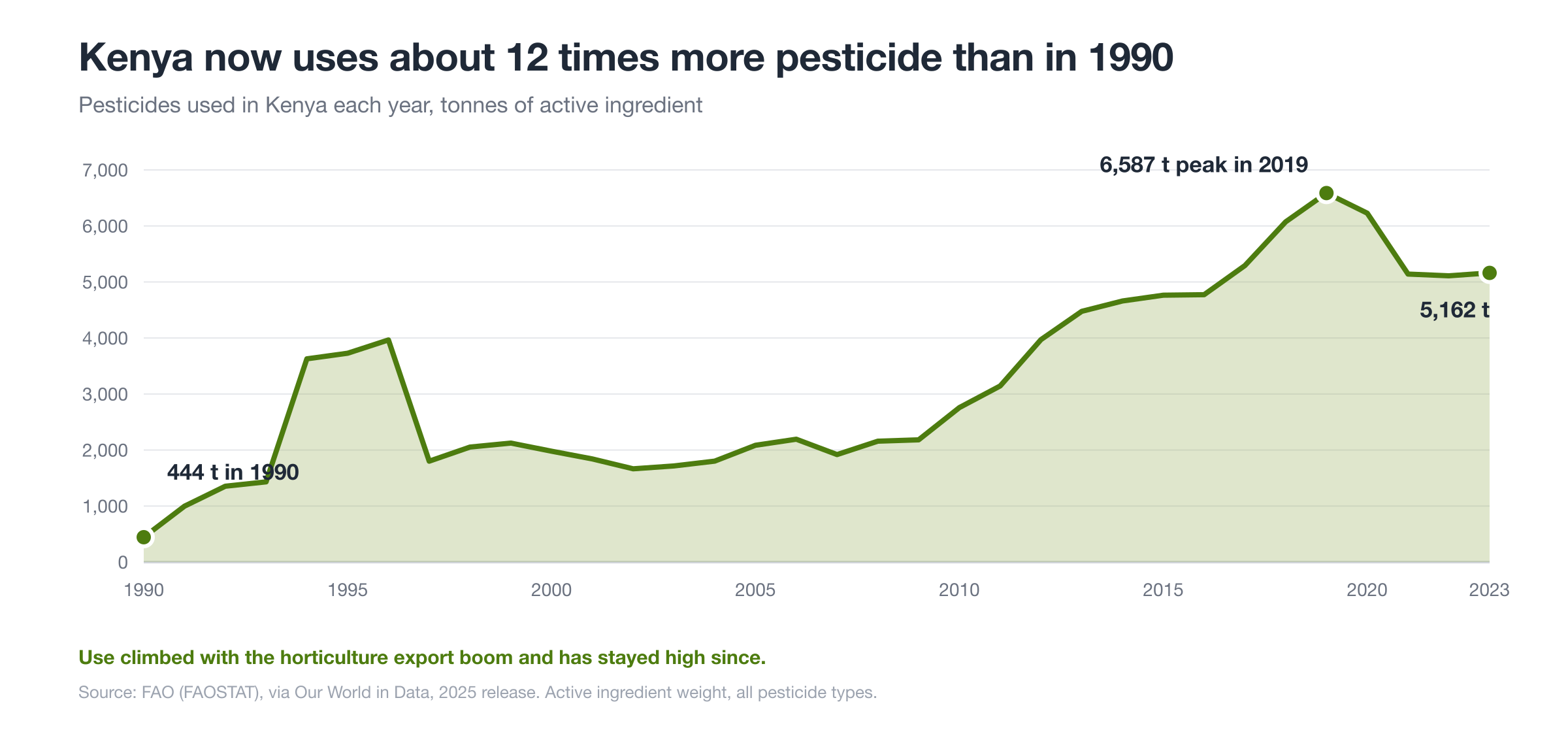
Timau is not an isolated case. It sits inside a much bigger shift in how Kenya farms. In 1990, the country used about 444 tonnes of pesticide active ingredient a year. By 2019 that figure had reached 6,587 tonnes, according to FAO data compiled by Our World in Data. The rise tracks the growth of flower and vegetable exports almost year for year.
Here is the part that often gets missed. Measured per hectare, Kenyan farms still use far less than European ones. The average Kenyan hectare received 0.69 kg of active ingredient in 2023, while the average hectare in the EU received 2.67 kg.

So the danger in places like Timau is not simply volume. It is which products are used, who does the spraying, how soon workers walk back into a freshly treated greenhouse, and whether anyone gives them gloves, masks and a place to wash. A national average also hides the farms that spray heavily and the many smallholders who barely spray at all.
A global problem with a familiar shape
Kenya's workers are part of a much larger story. A 2020 study in BMC Public Health estimated that about 385 million people suffer accidental pesticide poisoning every year, including around 11,000 deaths. That works out to roughly 44% of the world's farmers. The largest numbers are in South Asia, followed by South-East Asia and East Africa.
Some of the chemicals behind those numbers come from countries that will not let their own farmers use them. Export filings gathered by the investigative teams at Unearthed and Public Eye show EU companies planned to ship about 122,000 tonnes of pesticides banned in the EU in 2024, with around 9,000 tonnes bound for Africa. In April this year, a Greenpeace Africa report found that nearly half of the pesticide ingredients registered in Kenya are banned in Europe. France and Belgium have stopped their companies from exporting pesticides they ban at home. Most of Europe has not.
The companies argue that different countries weigh risk differently and that a product's legal status in Europe says nothing about its safety elsewhere. Campaigners reply that a farm worker's lungs work the same in Meru as in Normandy.
Kenya has started to act
Kenya's government has not stood still. In June 2025, the Agriculture Ministry announced the results of a review of 430 pesticide products. Seventy-seven were pulled from the market, 202 were restricted to certain crops, and imports of 151 more were halted while regulators took a closer look. Products banned under international chemical treaties can no longer be registered.
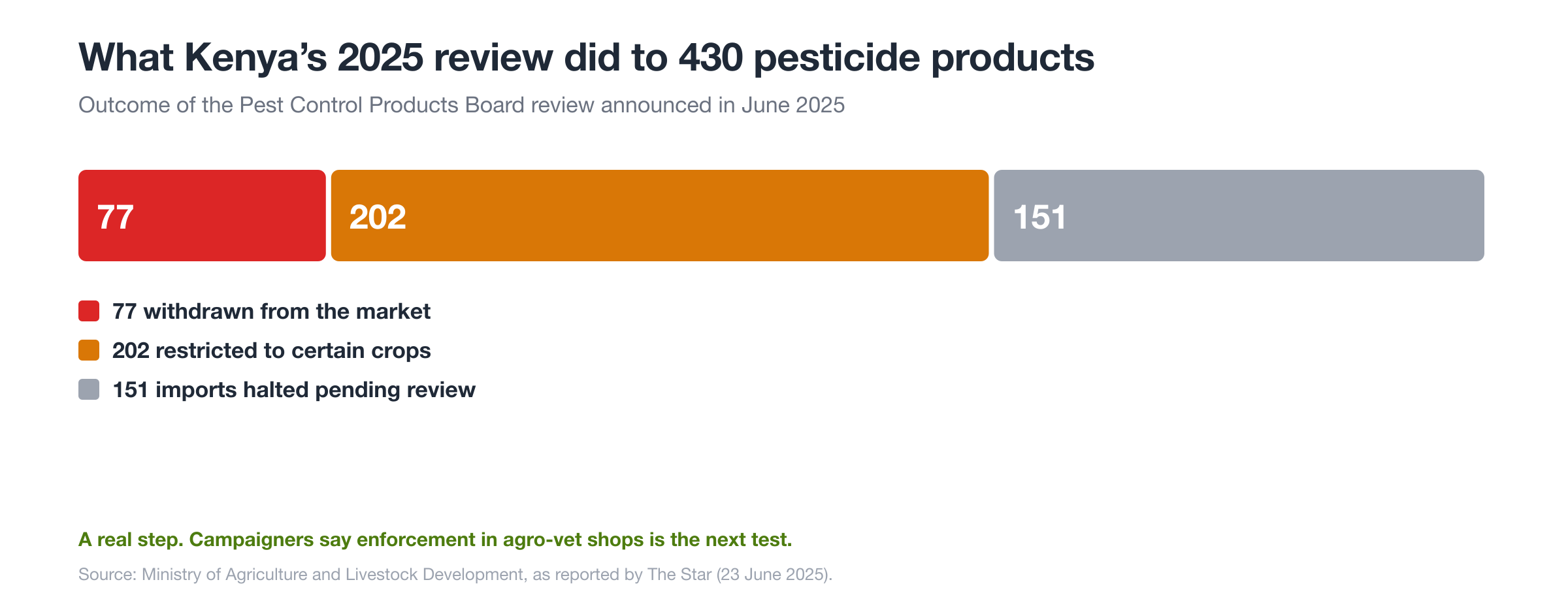
It was a real step forward, but rules on paper only help if they hold in agro-vet shops and on farms. Old stock lingers, smuggled products cross borders, and workers who fell ill years ago are not covered by any new ban.
The bill also arrives at the border
There is a hard economic side to this too. Europe tests imported food for chemical traces, and Kenyan beans and peas have been failing those checks more often. EU interceptions of Kenyan vegetables over residue limits rose from 25 in 2023 to 57 in 2024, and Europe tripled the share of consignments it inspects. Earnings from fresh vegetable exports fell from KSh 50.9 billion in 2023 to a provisional KSh 16.1 billion in 2025, according to official data.

The irony is hard to miss. Some of the same chemicals that worry workers in Timau are now costing exporters their best market. Safer spraying is no longer only a health question. It is a business one.
What farms can do this season
Courts and governments move slowly. Farms do not have to wait for them. A few habits make a real difference:
Respect the re-entry time. Every label states how long people must stay out of a treated field or greenhouse. Post it at the door and keep people out until it has passed.
Protect the hands and lungs first. Chemical-resistant gloves, a proper respirator for sprayers and long sleeves cost far less than one hospital stay.
Give people a place to wash. Clean water, soap and a change of clothes on site keep residues from going home to children.
Never reuse containers. Empty pesticide bottles should not end up holding water, milk or cooking oil.
Spray only what the problem needs. Identify the pest first, then pick the least toxic option that works. Our free pest and weed identification tool can help you name what you are dealing with before you reach for a sprayer.
Keep records. Writing down what was sprayed, when and by whom protects workers, and it is exactly what export buyers now ask to see.
Back in Timau, Muriki's mother told The Guardian that some weeks she cannot afford his medication. Whatever the court decides next year, the families in this town have already paid more than anyone should for a job in the fields. The least the rest of the industry can do is make sure the next generation of workers does not have to.