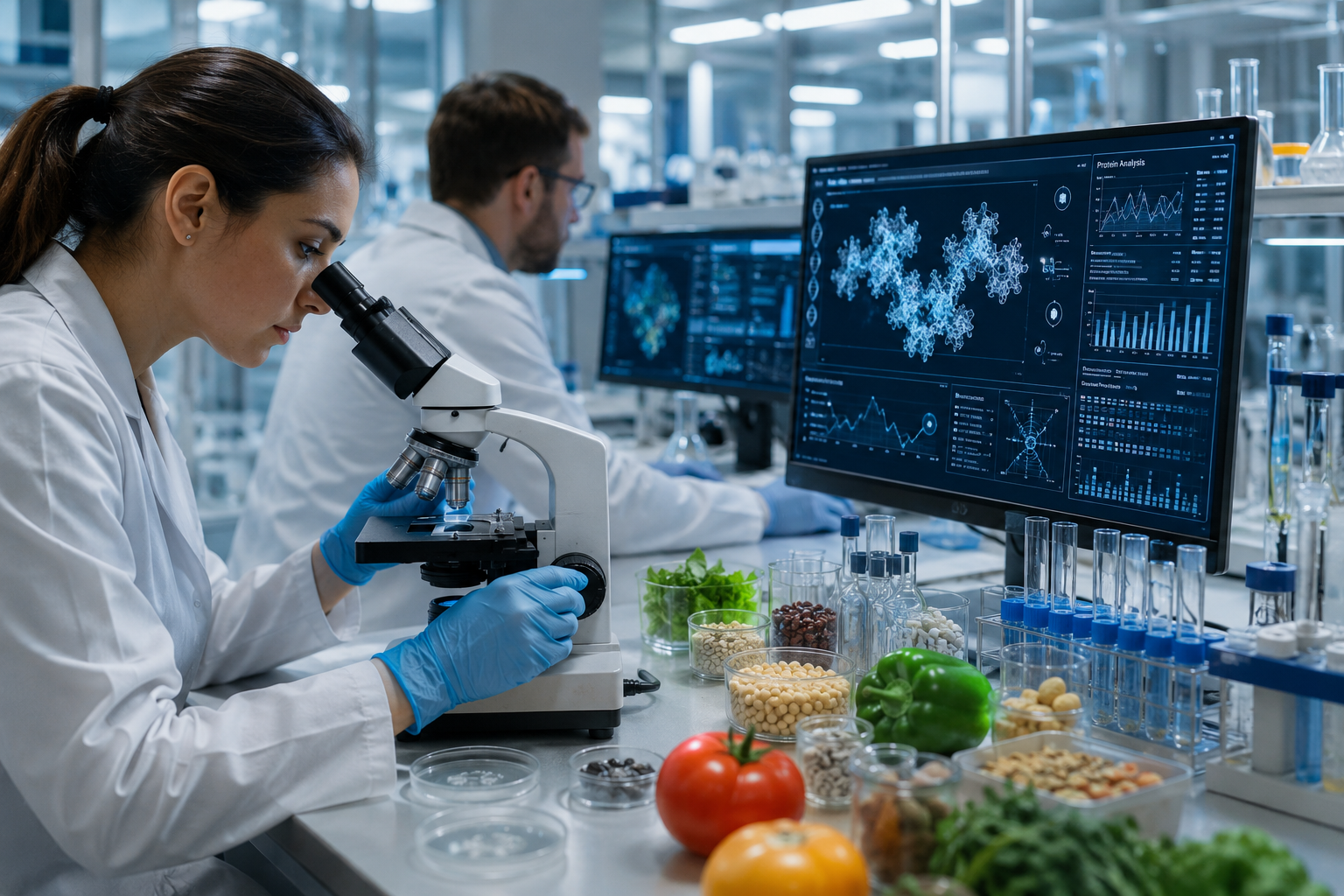
Something quietly remarkable is happening in the labs where our future food is being designed. Tools that once took scientists years to use are now doing their work in days. Questions about biology that seemed too tangled to answer are starting to unravel. Artificial intelligence has arrived in the science of food, and it is already changing what is possible.
But the people closest to this work are saying something that might surprise you. AI is powerful, yes. It is also far from a cure for everything. Knowing where it helps and where it gets in the way may matter just as much as the technology itself.
Seeing what the human mind cannot
Start with where AI truly shines. Living systems are staggeringly complex. A single cell juggles more moving parts than any person could hold in their head at once. We tend to think in a few dimensions. Biology works in dozens, all at the same time.
This is exactly the kind of problem machines are built for. Instead of chasing one target and ignoring the rest, AI can take in an entire system and spot patterns no human eye would ever catch. It can sift through nature and find a useful ingredient hidden inside a common plant, the kind of discovery that might have taken lifetimes of slow lab work to stumble upon. In this sense, the technology is not just speeding up science. It is letting scientists ask questions they could never ask before.
The cost and time of finding new breakthroughs have been falling for years now, and there is no sign of that slowing. If anything, the engine of discovery is only beginning to warm up.
Where the excitement cools
And yet, push past discovery and the picture gets more complicated.
Take the dream of personalization, the idea that everything we eat or take for our health should be tailored precisely to each individual. It sounds appealing. It also runs into a stubborn reality. What is good for one person is usually good for the next. Our bodies share far more than they differ. When you are trying to feed large numbers of people, designing around what we have in common often makes more sense than chasing endless variation. Not every problem is a personalization problem, and not every problem needs AI to solve it.
There is a practical side too. Building something clever is one thing. Making it affordable enough to actually reach people is another. A product can be brilliantly designed and still die on the way to market because the cost of launching it never adds up. The question is not only what AI can create, but whether what it creates can survive in the real world.
The proof still has to be earned
Here is the part the loudest voices tend to skip. We are not at the point where a machine suggests something and we simply trust it enough to sell it.
Creating a new ingredient is more than proving it works. Can it be made at scale? Can it hold up when it is actually used, mixed into everyday food and cooked the way people cook? AI can help flag these questions early, which is genuinely valuable. What it cannot do is erase the long road of testing that follows. Every real breakthrough still has to pass through human judgment, careful science, and the kind of patient checking that keeps what we eat safe.
For a while, AI seemed to mean the same thing as ambition and scale. That spell may be breaking in a healthy way. Some of the most promising new ideas in this field are not built on AI at all. The smartest players are no longer asking how to put the technology into everything. They are asking where it actually belongs.
The right tool, in the right place
None of this is a step backward. It is a sign of maturity. A field stops treating a new tool as magic the moment it learns to use it well.
The future of food will almost certainly be shaped by intelligent machines. But the most valuable skill in the years ahead may not be building those machines. It may be the wisdom to know when to lean on them and when to set them aside. The science is moving fast. The judgment guiding it still has to keep pace.