There are hundreds of millions of people who plant, weed, prune, and harvest the food the world eats. The crop they tend is mapped, satellite-imaged, and priced down to the kilogram. The land they work is surveyed and titled. The chemicals applied to that land are logged in some database somewhere. The workers themselves, however, are almost entirely absent from the data layer. Most farms could tell you the cubic litres of irrigation water they used last year. They could not tell you how many distinct people walked across the field in the same period, what each of them was paid, or what each was actually good at.
This is the gap that quietly defines agricultural labor in much of the world.
The popular narrative is one of shortage. Farmers cannot find workers. Wages are climbing. Young people are leaving the land. All of that is true in many places. But it is only part of the story, and arguably not the most important part. In many regions where farmers complain of acute labour shortages, other regions a few hundred kilometers away have a surplus of the same kind of worker. Nothing connects the two. The harvest peaks and troughs are predictable to within a week or two every year, and yet the matching of available hands to available work happens season after season through informal phone calls and personal favors.
The structure underneath is older than any of us. In most rural economies, labor moves through micro-networks managed by local team leaders who know everyone in the next three villages and almost no one in the next three districts. These networks are extraordinarily good at what they do at a small scale because they run on trust, repetition, and the personal credibility of one or two people in each community. They are also, by design, incapable of operating at the scale of a country. They produce thousands of independent micro-markets where one cohesive labor market should be.
Nobody is the villain in this picture. The system evolved because it works at the level where it lives.
What has begun to change is the cost of leaving the system alone.
Migration patterns are no longer holding the shape they used to. A high-value crop boom in one region pulls workers there for a season. A construction wave in another region pulls them out of agriculture entirely. Drought and heat reshape the calendar from year to year. Younger workers, more educated and more mobile than their parents, increasingly do not want farm work at all. Subsidy programs designed to provide a floor under rural incomes also reduce the urgency to look for daily wages. Each of these forces is reasonable in isolation. Together they make the supply of farm labor erratic in ways the old micro-networks were never designed to handle.
The downstream effects are already visible. Roughly a quarter of the global workforce still works in agriculture, and a substantial share of that work is informal, undocumented, and uninsured. International labor research consistently finds that informal employment still accounts for the majority of jobs in rural areas of low- and middle-income economies. When labor gets harder to find, the people most exposed are those with the least cushion. The workers themselves, who lose negotiating power. The smallholder farmer, who cannot pay the spike in peak-season wages. The broader rural economy, which loses output it could have produced.
This is where the more interesting work in agricultural technology is now happening.
Most of the past decade of agtech investment has gone into the things on a farm that can be seen from a satellite or measured by a sensor. Soil moisture. Canopy temperature. Pest pressure. Crop yields by hectare. These are useful problems, and the tools to solve them are improving. But the people doing the work have stayed in the background, where they have always been.
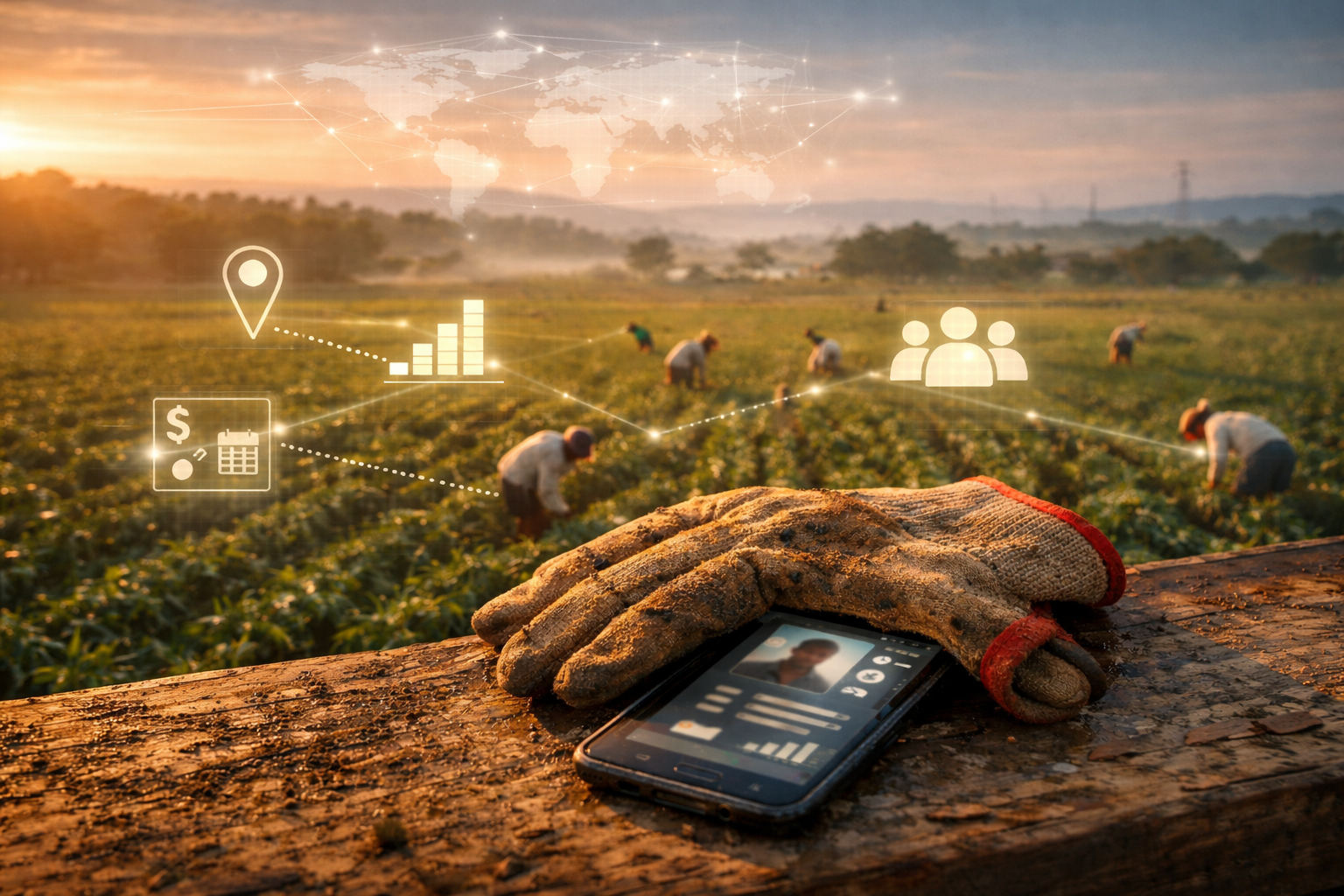
The shift now underway is to treat the workforce itself as something that can be mapped, understood, and supported with infrastructure of its own. The components are mostly familiar. A digital identity for each worker, capturing skills, work history, references, and earnings. A mapping of demand by crop, region, and week. A forecasting layer that combines weather, crop calendars, and migration patterns to anticipate where labor will be needed before the season arrives. And, crucially, an interface that does not ask a casual worker to learn anything new.
That last point matters more than it sounds. In rural settings with uneven digital literacy, the only platforms that get adopted are the ones that meet people where they already are. That usually means basic messaging applications and ordinary phone calls. The intelligence sits in the background. The user experience is whatever was already on the phone before.
The implications, if these systems mature, run further than efficiency.
A worker with a verified skill record can travel further for better work, because their reputation travels with them. A farmer with reliable advance information about labor supply can plant a more demanding crop with confidence. A regional authority planning infrastructure or social programs can do so against an actual map of where workers live, work, and move, rather than guessing. Several of these effects compound on one another. Mechanization, often presented as the alternative to labor, becomes more rational to plan when the labor picture is visible, because investment can target the gaps that remain rather than the shortages that are imagined.
There is a more basic dimension to this work that is easy to lose in the language of platforms and data.
Hundreds of millions of agricultural workers currently live with no formal record of what they do for a living. No employment history, no portable proof of competence, no documented relationship with the wages they earn or the people they earn them from. The basic apparatus that allows workers in other industries to plan a life, take a loan, change jobs, or claim benefits simply does not exist for them. Building it is not a side effect of digitizing the workforce. It is closer to the point.
The yardstick most often used in these discussions is the number of days of paid work a rural worker can reliably count on in a year. In many of the affected economies, the current floor is below one hundred days. A working target is three hundred. The gap is enormous in human terms and almost entirely about coordination rather than the underlying availability of work.
The next decade of progress in agriculture will not be defined only by what happens to crops. It will be defined, increasingly, by what happens to the people who grow them.