Few foods start an argument faster than a steak. In wealthy countries, governments are revising their national food guides, and one question keeps coming back: should people be told to eat less red meat, for their health and for the planet?
On one side are researchers who point to links between high meat intake, heart disease and some cancers, and to the methane that cattle release. On the other side, a growing group of nutrition and livestock scientists argue that meat is one of the most nutritious foods we have, and that grazing animals on grassland are part of a natural cycle that numbers on a spreadsheet tend to miss.
Both camps have a point. But the debate often skips a simple fact. How much meat is "too much" depends on who is eating it.
The world does not eat the same meal
The best-known blueprint for a healthy, planet-friendly diet comes from the EAT-Lancet Commission. Its Planetary Health Diet allows about 14 grams of red meat and 29 grams of poultry a day. That is roughly 16 kilograms of meat a year, or one small burger and a few pieces of chicken each week.
Now look at what people actually eat. According to FAO data compiled by Our World in Data, the average American had access to about 122 kilograms of meat in 2023. An Australian had 117 and a European 79. The average Kenyan had about 10. In Ethiopia and India, it was closer to 7 or 8.
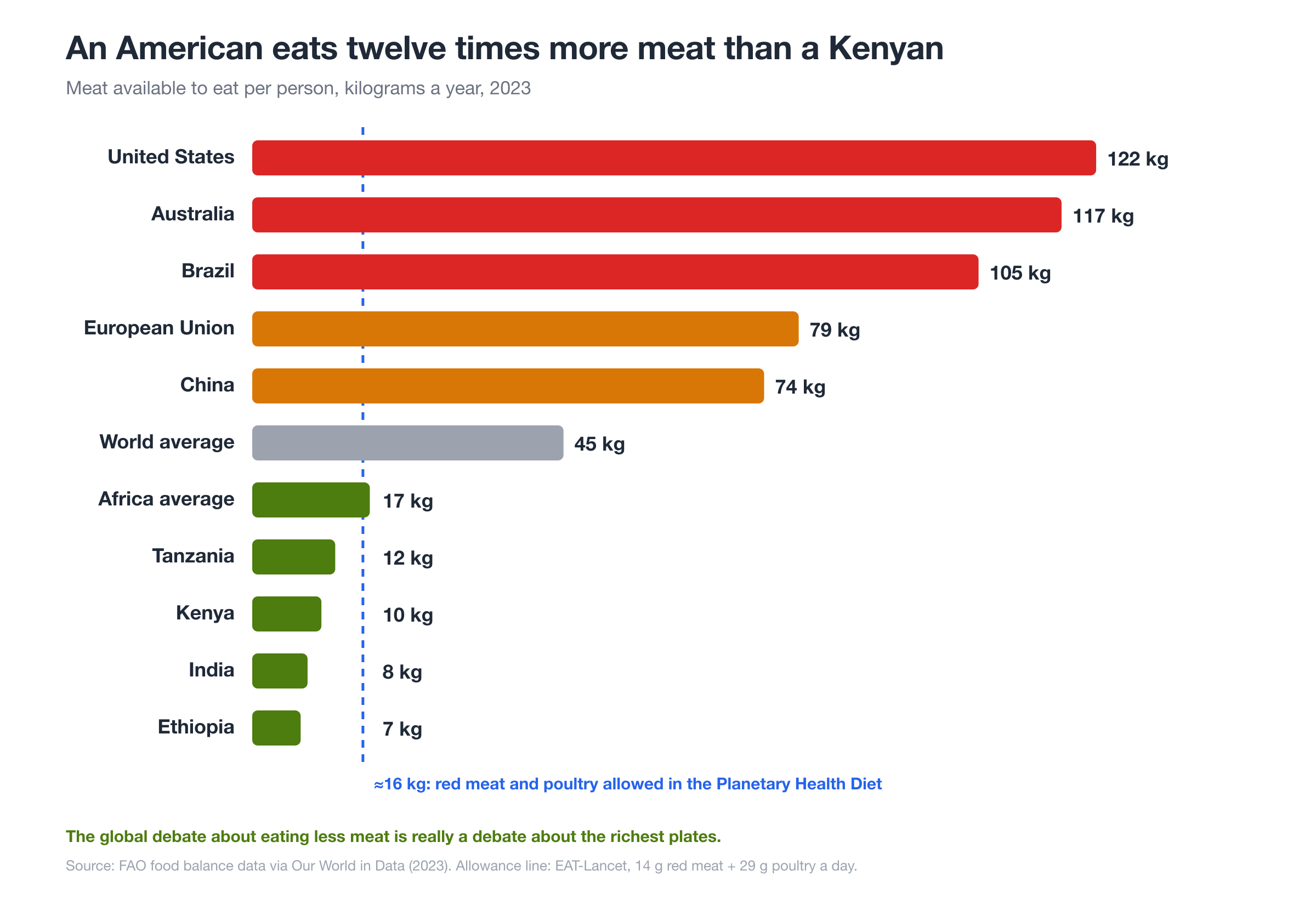
The global average sits at 45 kilograms. Africa as a whole is at 17, just about on the Planetary Health Diet line. Kenya is below it.
So when someone in a rich country says "eat less meat," the advice makes sense for the person eating meat twice a day. It makes far less sense for a child in a rural village who might see meat once a fortnight.
Why a little meat goes a long way
Meat is not just protein. It is one of the richest natural sources of three nutrients many people in poorer countries lack: iron, zinc and vitamin B12.
A 100-gram serving of cooked lean beef gives an adult woman more than half her daily protein, about four-fifths of her zinc and all the vitamin B12 she needs, based on values in USDA FoodData Central. The same serving of cooked kidney beans gives far less zinc and no B12 at all. Beans do have real strengths. They are cheap, rich in fibre and kind to the soil. But they cannot do everything on their own.
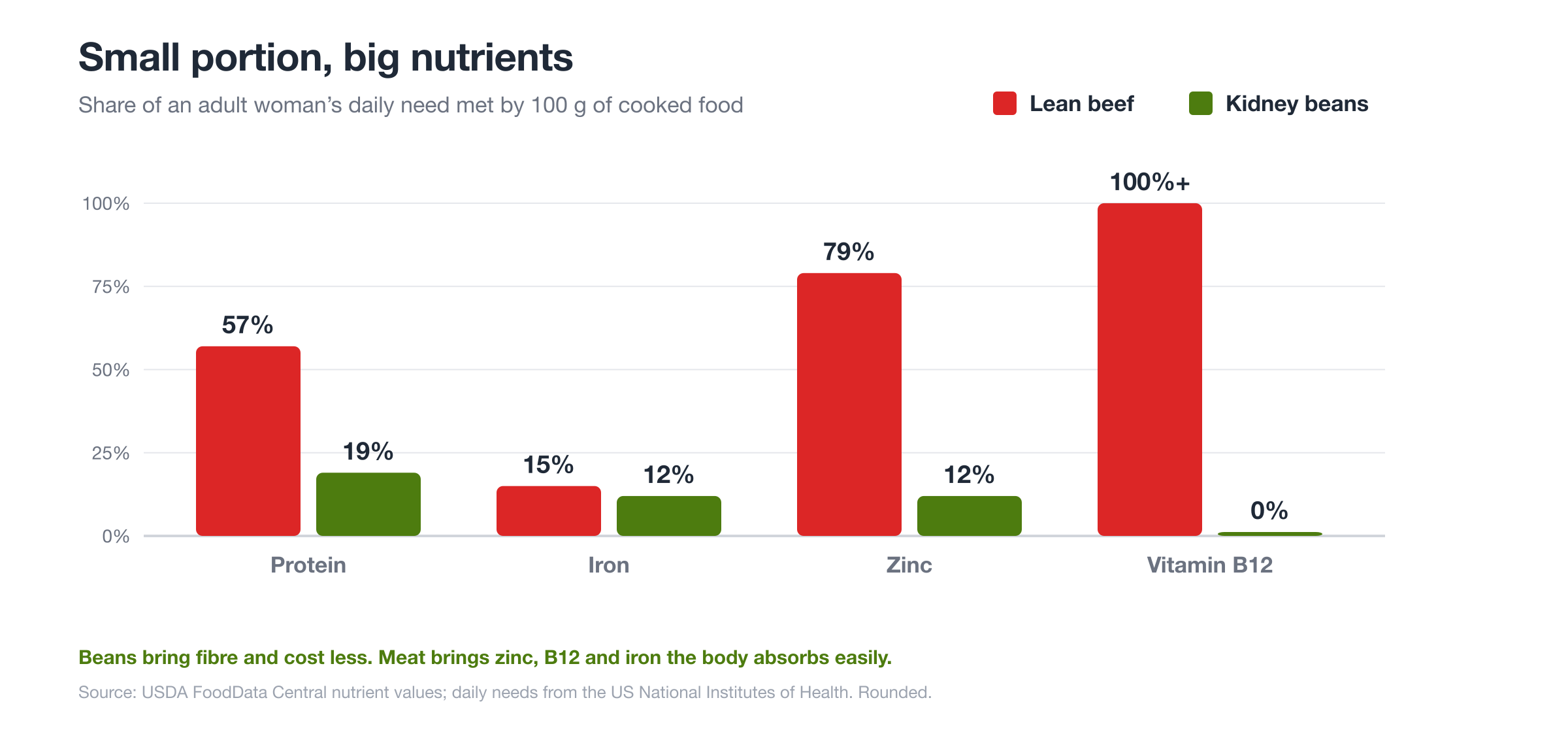
There is another difference the chart does not show. The iron in meat is the type the body absorbs most easily. Iron from beans and greens is harder to take up, especially in meals heavy in maize or tea.
This matters because shortages of these nutrients are common. The World Health Organization estimates that anaemia affects about 30% of women aged 15 to 49 around the world and roughly 40% of children under five, and it is most common in Africa and South Asia.
Kenya's steady progress
Kenya has made real gains. The share of children under five who are stunted, meaning too short for their age because of poor nutrition, fell from 35% in 2008–09 to 18% in 2022, according to the Kenya Demographic and Health Survey.
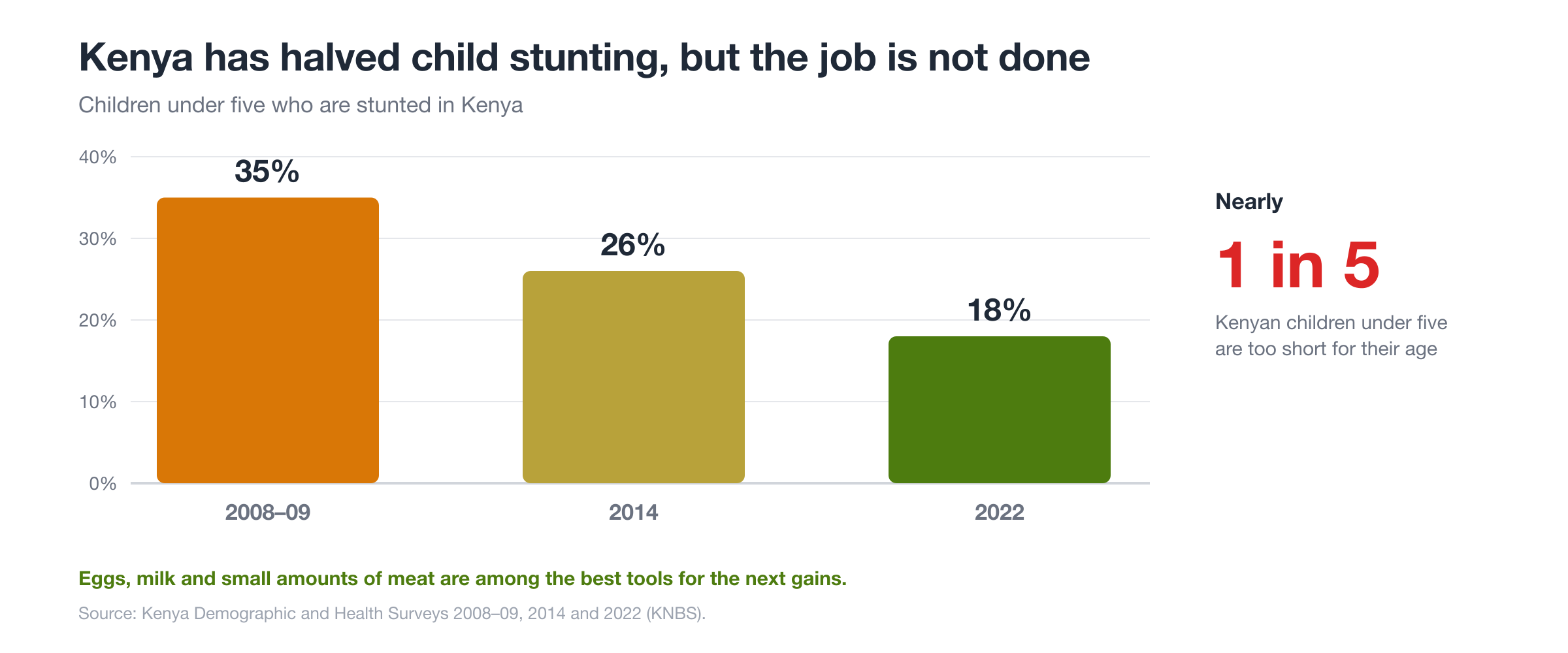
That is still nearly one child in five. Research in many low-income countries links foods such as eggs, milk and meat with better growth in young children, because they pack so many nutrients into small portions that little stomachs can manage. For families who keep chickens, goats or a dairy cow, part of the answer is already in the backyard.
What about the climate?
Livestock do have a climate cost. The FAO's Pathways towards lower emissions report puts livestock at about 12% of all greenhouse gases caused by people, with cattle responsible for most of that, mainly through methane released as they digest grass.
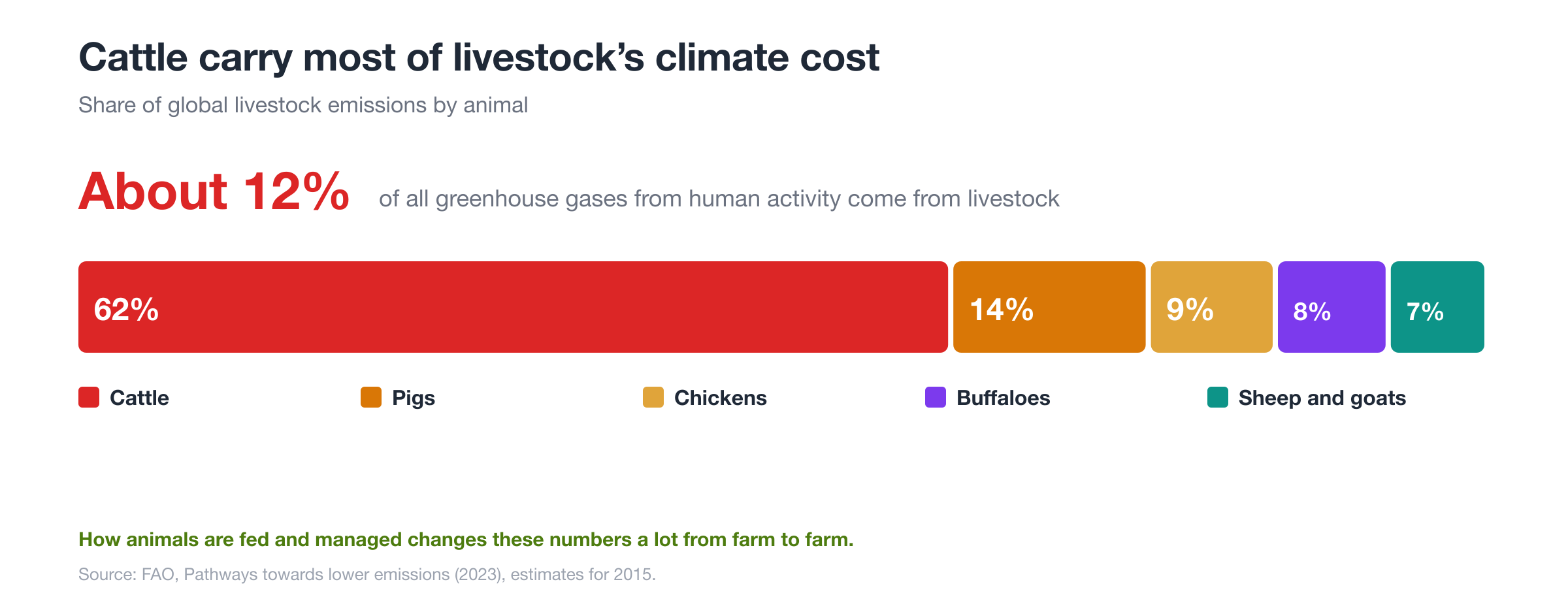
The detail matters, though. Emissions per kilogram of meat or litre of milk vary hugely from farm to farm. A healthy, well-fed cow that grows quickly and gives more milk produces far less methane per unit of food than a thin, sick animal that takes years to reach market. In much of Africa, the biggest climate gains will come from better feed, better animal health and better breeding rather than from fewer animals.
Grazing also has value that is easy to overlook. Large parts of Kenya are too dry to grow crops. On that land, cattle, camels, sheep and goats turn grass people cannot eat into milk and meat they can. For millions of pastoral families, livestock are food, savings and insurance all at once.
Finding the middle ground
The honest answer to the meat debate is that both sides are right in different places.
For people in wealthy countries eating large amounts of processed and red meat every day, cutting back is sensible advice. For families in Kenya and much of Africa, the goal looks different: a little more good-quality animal food, raised well, for the people who need it most, especially children and pregnant women.
For farmers, that points to a clear opportunity:
Raise healthier animals. Good feed, clean water, vaccination and parasite control lift growth and milk yield while cutting emissions per animal.
Keep small stock and poultry. Chickens and goats are affordable, multiply quickly and put eggs and meat on the family table.
Sell quality. Clean handling, proper slaughter and cold storage earn better prices and protect consumers.
The world does not need one rule for every plate. It needs the right amount of the right food in the right place. If you want to raise healthier, more productive livestock, explore the practical farmer courses on Eagmark Training.